

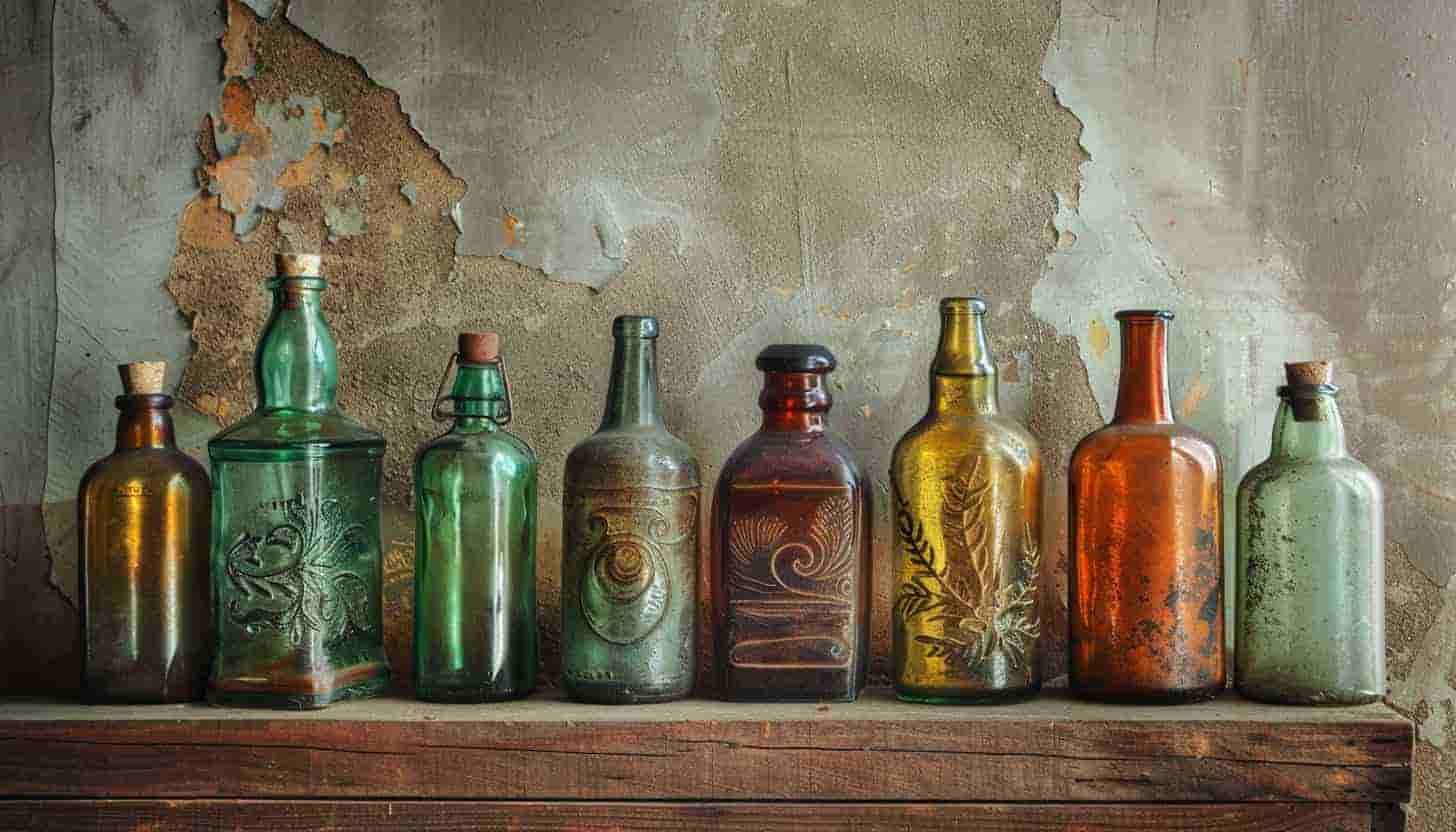
Figuring out how old a Glass Bottle is seems like work for antique experts. But you can do it yourself with the right knowledge. The glass tells a story through simple clues. Look at how it was made. Check the marks left by bottle-making machines. Even the flaws show its era.Learning these seven clear signs will turn you into a confident bottle detective.

Why Bottle Age Dating Is (Almost) Guesswork
Here’s the truth: Glass bottles don’t come with birth certificates. Unlike modern items with printed dates, antique bottles reveal their age through physical clues—but these usually point to a timeframe, not an exact year.
Manufacturing methods didn’t change overnight. For example, hand-blown traits might appear from 1840 to 1900, while early machine-made features could span 1905 to 1930. Glassmakers adopted new technology slowly, meaning old and new techniques often existed side-by-side in different factories—or even the same one. Different storage conditions can also affect the aging degree of glass bottles.
Take mold seams: a side seam stopping below the neck generally means pre-1900s, but that’s still a 50+ year window. A seam running through the lip suggests post-1903 machine production—yet those machines ran for decades using similar molds.
The key is to combine every clue: closure type, glass color, mold marks, embossing, and base wear. Together, they can help you distinguish, say, an 1880s–1900s bottle from a 1920s one. While you may rarely pin down an exact year, that window of history is often precise enough to uncover a bottle’s story—and its true value.
Method 1: Mold Seam Position – Your Most Reliable Age Indicator
The vertical line running up the side of a bottle tells more about its age than most other features. This mold seam formed where two halves of a glass mold came together during production. Where that seam stops reveals when the bottle was made.
Reading the Seam Height Chart
Bottle expert Julian Kendrick created a reliable age gauge in 1963. Collectors still use it today. His research linked mold seam height to specific production eras spanning the 1800s through the 1900s.
Before 1860, mold seams ended low on the bottle. Look for the seam stopping at the shoulder or climbing just onto the lower neck. These first commercial bottles show the most basic manufacturing.
Between 1860 and 1880, glassmaking improved. The seam climbed higher but stopped just below the finish (the top portion with the opening). You’ll see a clear gap between where the seam ends and where the lip begins.
From 1880 to 1900, seams reached even higher. They ended within the finish itself, stopping just below the rim. This marks the peak era of skilled mouth-blown bottle production.
After 1900, automatic bottle machines changed everything. Seams now ran all the way to the top surface of the finish. No gap. No stopping point. The seam went straight through to the rim.
Machine-Made Seam Characteristics
Machine production created distinct seam patterns. Machine-made bottles from 1905 to the 1920s displayed thick, bold seams – several times the width of a human hair. You could feel these raised lines with your fingertip.
Post-1920s technology refined the process. Seams became thinner, approaching hair-width thickness. These later machine seams looked finer and narrower than their mouth-blown predecessors.
The 1880-1910 transition period created an interesting overlap. Some bottles show seams reaching the top of the neck but stopping before the lip. This points to semi-automatic tooling methods that bridged hand and machine production.
Method 2: Lip/Finish Type – Dating From the Bottle Mouth
The bottle top reveals manufacturing secrets most collectors miss. The finish is the technical term for the lip and opening portion. Glassmaking evolved, and the finish changed with it. These finish types help you date bottles from the 1800s through the 1910s.
Applied Finish: The 1840s-1880s Standard
Applied finishes ruled American bottle production before 1880. Glassblowers added a separate blob of hot glass to the bottle’s neck opening. They shaped it with tools while the glass stayed molten.
You can spot an applied finish through specific markers. The side mold seam stops right at the base of the finish. No gradual fade. Just a clean endpoint where the finish begins.
Run your finger inside the bottle neck. An applied finish creates a rough ridge or line where the added glass meets the original neck. This interface feels different from the smooth glass below it. That rough texture is your best confirmation.
Tooled Finish: The 1870s-1910s Transition
Tooled finishes replaced applied methods starting in the 1870s. Glassblowers shaped the finish from the bottle’s original neck glass. They used rotating hand tools instead of adding separate glass.
The mold seam behavior changed. The seam now fades out on the neck within about one inch below the finish bottom. It might bend a bit or trace upward toward the rim.
Inside the neck, you’ll feel smooth glass. No rough ridge. No interface line. The transition from neck to finish flows smooth because they’re formed from the same piece of glass.
Comparison Chart for Quick Identification
|
Feature |
Applied Finish |
Tooled Finish |
|---|---|---|
|
Mold seam ending |
Stops at finish base |
Fades on neck, about 1″ below finish |
|
Inside neck texture |
Rough ridge/line present |
Smooth |
|
Seam in finish area |
Never (applied separately) |
Sometimes faint traces visible |
|
Common dating range |
Pre-1880s dominant |
Post-1870s through 1910s |
|
Production method |
Added hot glass blob |
Shaped from neck glass |
Sheared and Ground Lips: The Earliest Bottles
Bottles made before 1850 often feature sheared or cracked-off lips. Glassblowers snapped the bottle off the blowpipe. This left the top flat and rough.
Touch the top surface. It feels like fine sandpaper. Tiny chips and roughness appear around both the inner and outer edges. The mold seam runs right to the top rim edge without curling over. The glass often looks uneven or stretched a bit.
Dating Strategy Using Lip Types
Applied finishes point to pre-1880s production. A late 1870s to 1880s open paneled flask provides good evidence if it shows an applied finish.
Tooled finishes dominated the 1870s-1910s era. The exact transition timing varied by bottle type. Medicine bottles switched before liquor bottles. beer bottles adopted tooling at different rates than soda bottles.
The mid-1800s brought specific tooled lip styles. Tapered lips appeared. Double-tapered finishes served mineral water bottles. Double-rounded, tooled-flared, and squared-off lips marked different product categories.
Your Four-Step Inspection Process
1. Check the mold seam endpoint. A stop at the finish base indicates applied. A gradual fade on the neck indicates tooled.
2. Feel inside the neck. A ridge confirms applied. Smooth glass confirms tooled.
3. Inspect the top surface. Flat, rough, or chipped texture points to sheared or ground lips from earlier eras.
4. Cross-reference with bottle type. A medicine bottle with an applied finish dates different than a beer bottle with the same feature. Each category adopted new methods on its own timeline.
Method 3: Base Markings – Pontil Scars, Suction Marks, and Machine Scars
Flip your bottle over. Check the base. The bottom tells you how glassblowers separated the finished bottle from their tools. You’ll find three different mark types. Each one shows a specific way bottles were made and helps date your piece.
Pontil Marks: The Hand-Blown Era Before 1860
Look for a rough, circular scar on the bottle base. This rough patch formed a specific way. Glassblowers snapped the finished bottle off the pontil rod. That’s the metal tool that held the bottle during shaping and finishing work.
The mark measures ½ to 1½ inches across. The glass feels jagged or uneven inside this circle. Sharp glass bits often stick out. Some pontil scars show a ring pattern where the rod touched the base. Others show a solid rough patch.
Pontil marks ruled American bottle making through the 1850s. Finding one means your bottle dates to 1860 or before. Free-blown bottles almost always have these scars. Three-piece mold bottles from the 1820s-1840s show them too.
Owens Suction Scars: The 1905-1920s Machine Signature
The Owens Automatic Bottle Machine made a “feathered” circular scar. This mark differs from pontil scars. The scar sits off-center instead of dead center on the base. Fine feather-like lines spread out from a circular dip.
The Owens machine used vacuum suction to hold bottles during making. The suction released and left this texture pattern. The feathered look is your key clue – pontil marks don’t have these delicate lines.
Owens machines changed production from 1905 through the 1920s. A bottle with this suction scar dates to this twenty-year span. The mark runs smaller than pontil scars, about ¾ to 1 inch across.
Smooth Machine Scars: Post-1920s Mass Production
Modern bottle machines leave very little base evidence. The base shows a small, smooth circular mark or slight valve dip. No roughness. No feathering. Just a faint ring or shallow dimple.
These bottles have full-height mold seams running to the top rim. The base marking plus through-the-top seams confirm 20th century machine making. Production dates to 1920s forward. That’s the point where better machines replaced older technology.

Method 4: Embossing and Manufacturer’s Marks – Decoding the Codes
Raised letters and symbols stamped into glass tell a specific story. These marks show who made the bottle, where, and often when. Makers left these permanent records for brand protection and quality control. You can use them to pin down your bottle’s age.
Where to Look for Embossed Information
Scan three key areas on every bottle. The body sides show the clearest markings. Product names appear in large letters. Company names sit below or above. City locations often appear at the bottom of the main panel.
The base carries maker codes and date marks. Turn the bottle upside down. Look for raised numbers, letters, or symbols pressed into the glass. These codes identify the glass company that produced the bottle, not the brand that filled it.
The heel—the thick area where the base meets the body—sometimes holds patent dates or size measurements. Check this curved area with care. Markings here are smaller. Dirt or mineral deposits can hide them.
Matching Marks to Production Periods
Glass company logos changed over the decades. Owens-Illinois Glass Company used different marks from 1929 through the 2000s. Their diamond-over-I symbol appeared from 1929-1954. A duraglas mark dates bottles to 1940s-1960s. These logo changes create dating windows.
Patent dates give you solid reference points. A bottle stamped “PAT’D NOV 26 1867” wasn’t made in 1867. That date shows when the bottle design got patent approval. Production could run 20-30 years after. But the patent date sets a “not-before” line. Your bottle can’t be older than its patent date.
Cross-Referencing Mark Styles
Letter styles changed through the eras. Fancy, serif fonts ruled 1870s-1890s embossing. Simple block letters became standard after 1900. Script lettering peaked in the 1920s-1940s for certain products like cosmetics and sodas.
Size markings followed legal rules. Federal laws from 1913 forward required fluid measurements on containers. Bottles marked “FLUID OUNCES” or “OZ” date to 1913 or later. Earlier bottles used informal size descriptions or no size marks at all.
Method 5: Glass Color as a Supporting Clue (Not Primary Evidence)
Glass color catches your eye first. That blue-green tint or deep purple shade seems like it should reveal the bottle’s age right away. But color alone misleads more than it helps. The same shade can appear across a century of production. Different chemical recipes create identical colors. Sunlight and soil chemistry change the original hues.
Use color as backup evidence, not your main proof. Combine it with manufacturing features, mold seams, embossing, and base marks. That’s when color adds value to your age assessment. By itself, color creates false conclusions.
Common Color Ranges and Their Limitations
Aqua or pale blue-green glass dominated mid-1800s to 1900s utility bottles. Medicine bottles, soda bottles, and fruit jars show this tint. The color came from iron impurities in soda-lime glass formulas. Glassmakers didn’t remove the iron because it cost money. Customers didn’t care about color for everyday containers.
The aqua shade doesn’t pin down specific decades. A bottle from 1860 can match the exact color of one from 1910. The tint tells you it’s utility glass from a broad 50-year window. You still need seam position and lip type to narrow the date range.
Colorless glass became common after 1870-1880 in American bottles. Earlier colorless glass exists but appears less often. A slight green or straw tint in otherwise clear glass hints at pre-World War I production. This clue works best with manufacturing features. Post-1920s bottles also show faint tints. It depends on raw material sources.
Dark olive green or “black glass” served wine and beer bottles through the 1700s-1800s. British and colonial bottles used this color widely. The heavy, dark tint protected contents from light. Experts have studied high-calcium dark olive-green wine bottles. They use thickness measurements for dating. But the color itself doesn’t date the bottle. The glass composition and wall thickness create the timeline, not the shade.
Method 6: Glass Bottle Flaws and Texture – Reading the Glass Quality
Smooth, perfect glass marks modern manufacturing. Old bottles tell a different story through their flaws. Tiny bubbles, uneven walls, and rippled surfaces show the glassmaking technology of their time. These flaws aren’t defects—they’re age signatures left by hand-blown production and old mechanization.
Air Bubbles and Seeds: Pre-Machine Glass Traits
Look for tiny bubbles trapped inside the glass walls. Collectors call these “seeds.” They measure from pinpoint size to 1/8 inch across. Some bottles contain dozens scattered throughout the body and neck.
Seeds formed during melting. Air got trapped in the process. Old furnaces ran at lower temperatures. The glass batch didn’t melt smooth. Air pockets stayed locked in the molten material. Glassblowers shaped bottles. These bubbles remained frozen in the cooled glass.
Bottles made before 1900 show the most seeds. Hand-blown production from the 1840s-1890s displays this feature. The number and size vary by factory quality standards. Premium bottles show fewer seeds. Utility bottles—medicine containers, food jars, common sodas—contain more bubbles.
Machine-made bottles after 1905 reduced but didn’t eliminate seeds. Better furnace technology and refined glass formulas created cleaner material. A bottle packed with many visible seeds points to pre-1900 hand production. Machine-made glass shows fewer, smaller bubbles if any appear at all.
Ripples, Waves, and Surface Texture
Tilt the bottle under direct light. Look for wavy patterns or ripples running through the glass surface. These texture variations appear as subtle distortions. They make light reflect in uneven ways across the body.
The rippling came from uneven glass temperature during shaping. Hand-blown production couldn’t maintain perfect heat. Some glass sections cooled faster. Others stayed molten longer. This created stress patterns that remained visible after final cooling.
Semi-automatic machines from 1890-1910 also produced rippled glass. The technology bridged hand and full automation. Bottles from this transition period combine machine seams with hand-blown texture flaws. You might find through-the-top seams plus visible rippling—proof of old mechanization.
Post-1920s bottles show minimal surface texture. Modern annealing processes (controlled cooling) got rid of most stress patterns. The glass appears clean without waves or distortions.
Method 7: Closure Type – Cork, Screw, or Specialty Stoppers
Check the top of your bottle. The closure tells you a lot about when it was made. Many collectors miss these clues. Cork ruled American bottle making from colonial times through the mid-1900s. Metal caps, screw threads, and specialty closures came later. Each closure type marks a specific time period. This helps narrow down your bottle’s age.
Cork Closures: The Standard From 1700s-1950s
Cork stoppers sealed bottles for over 200 years. Wine, beer, medicine, and spirits all used cork. Natural cork comes from Portuguese oak bark. Portugal still makes 16 billion corks each year for the world market.
Look at the bottle opening for cork signs. A smooth, round opening with no threads means cork closure. The inside stays the same width from rim to neck. No ridges. No spiral grooves. This smooth opening means pre-1920s for most bottles.
Screw Caps and Threads: The 1920s-Forward Change
Threaded bottle necks mean 1920s or later. Metal screw caps replaced cork in the early 20th century. Making glass threads took precision. Automatic bottle machines from the 1920s made this work on a large scale.
Feel for raised spiral threads inside the bottle neck. Run your finger around the opening. You’ll feel clear ridges that form the screw pattern. These threads appear on machine-made bottles. Hand-blown bottles couldn’t make even threading.
Screw caps took time to catch on. Wine makers avoided them through the 1950s-1970s. Australia and New Zealand used them sooner. By the 2000s, screw caps sealed 37% of still wine bottles around the world. New Zealand puts them on 90% of wines. A threaded wine bottle dates after 1980 unless other features say different.
Crown Caps: The 1892 Beer Bottle Change
William Painter got the crown cap patent in 1892. This crimped metal cap with cork liner changed beer and soda bottling. The design needed a raised ring or “crown” molded into the bottle neck. Metal tools bent the cap edges around this ring.
Look at the bottle neck for a thick, raised collar about 1/4 inch below the top rim. This crown finish held crown caps. Beer bottles with this date to 1892 or later. This design ruled beer and soda packing through the 1960s.
Crown caps worked great for fizzy drinks. The tight seal held pressure. The cap came off with simple openers. Making them cost less than cork. A crown finish puts your bottle in the 1890s-1970s range for most beer and soda.
Lightning Stoppers and Wire Bails: The 1875-1920s Type
Glass or ceramic stoppers held by wire bails showed up on certain bottles. These lightning stoppers or swing-top closures locked with metal wire loops. A rubber gasket made the seal. Flip the wire bail up. The stopper came out. Flip it down. The stopper locked.
Beer bottles, mineral water, and some food jars used this system. The design came out in the 1870s. Top making ran from 1880-1920. Most lightning stoppers vanished after automatic crown capping machines arrived.

Conclusion
Dating a glass bottle stops being guesswork once you know the clues. The mold seam is your best friend here. Trace it from base to lip. This narrows down the era by decades. Add base markings, lip styles, and embossing codes. You’re building a complete timeline instead of relying on one clue.
At TP Glass Bottle Manufacturer, we honor this rich legacy of glassmaking while utilizing modern techniques to produce high-quality, customizable glass bottles for today’s needs. Whether you’re a collector, a historian, or a business looking for reliable packaging, we blend tradition with innovation to create bottles that stand the test of time. Let us help you bring your vision to life—contact us to discuss your next project.