

Custom glassware plays an important role in product packaging and brand presentation for many businesses. Selecting a reliable custom glassware manufacturer is essential, as it directly affects product quality, production efficiency, and how well your design requirements are met. With a wide range of suppliers in the market, knowing what to look for can help you avoid unnecessary risks. This guide will cover the key points you need to consider when choosing a manufacturer that fits your business needs.
Table of Contents
What Is a Custom Glassware Manufacturer (and Why It Matters for Your Brand)
Here’s something most buyers figure out too late: the company quoting you isn’t always the company making your bottles.
A true custom glassware manufacturer owns its furnaces, molds, and production lines. It controls every step — from raw silica sand to finished custom glass containers ready for your label. A trading company works differently. It acts as a middleman. It sends your order to whichever glass bottle factory offers the best margin that week. The website looks just as polished. The accountability? Not even close.
That gap hits your brand hard. Quality issues do come up in glass production — it’s part of the process. A direct manufacturer can trace the problem to a specific mold, batch, or kiln setting. A middleman makes phone calls and hopes for the best.
OEM, ODM, or Private Label — Which Model Fits Your Stage?
Pick the partnership model that matches where your brand is right now.
- OEM (Original Equipment Manufacturer): You provide the design specs. They produce it. This works best for established brands with a defined packaging identity that need bulk glass bottles made to exact standards.
- ODM (Original Design Manufacturer): They design it. You put your brand on it. Great for growing companies that want custom-looking glassware without paying for new tooling from scratch.
- Private Label: Pre-made forms, your logo applied. This is the fastest, lowest-cost option for startups testing a product before committing to custom molds.
Sort out which model fits your needs before you start sourcing. You’ll cut your evaluation time in half. Plus, you won’t end up paying ODM prices for what should have been a simple private label order.
5 Non-Negotiable Certifications Every Custom Glass Packaging Manufacturer Must Have
Certifications aren’t paperwork. They’re proof that a manufacturer has been tested by someone outside their own walls.
Check the cert stack before you look at pricing or lead times. A custom glass packaging manufacturer without the right credentials is more than a risk. It’s a liability. It can stop your product at customs, block retail distribution, or trigger a recall that costs you far more than the savings ever would.
Here are the five that matter:
1. ISO 9001 — The Baseline for Quality Systems
ISO 9001 tells you one thing: this factory has a documented, audited process for keeping quality consistent. Glass bottle production deals with real batch variation. That’s an operational headache. ISO 9001 shows the factory has systems in place to manage it. No ISO 9001? Move on.
2. FDA Compliance — Non-Negotiable for the U.S. Market
Your custom glass containers will hold food, beverages, pharmaceuticals, or supplements sold in the United States? FDA compliance is not optional. It confirms the glass composition and manufacturing process won’t push harmful substances into your product. Spirits brands, hot sauce companies, supplement manufacturers — this one’s yours to own.
3. LFGB Certification — The European Standard Worth Demanding
LFGB is Germany’s food safety framework. It’s one of the strictest in the world. Your glass packaging solutions are heading into EU markets? Request LFGB test reports. You want a higher safety benchmark across all markets? Same answer. Many solid glass bottle factories carry LFGB alongside FDA compliance — that’s a good sign.
4. BSCI — The Social Audit That Protects Your Brand Reputation
BSCI audits check labor practices, working conditions, and ethical sourcing inside the factory. Retailers like Walmart, ALDI, and major European chains require it from their suppliers. You’re selling into those channels? BSCI is a must. You’re building a brand that can’t survive a labor scandal? Also a must.
5. SGS or Intertek Third-Party Testing Reports
This isn’t a certification body. It’s a verification layer. SGS and Intertek are independent testing organizations — they answer to no one but the data. A manufacturer who shares current third-party test reports on their specialty glass products is showing you transparency. One that pushes back? Ask why. That answer tells you a lot.
Quick reference by industry:
| Application | Must-Have Certs |
|---|---|
| Food & Beverage | ISO 9001, FDA, LFGB |
| Spirits & Liquor | ISO 9001, FDA |
| Fragrance & Cosmetics | ISO 9001, SGS/Intertek reports |
| Pharmaceuticals | ISO 9001, FDA, LFGB |
Ask for the actual documents — not just a checkbox on a supplier profile. Any reputable custom glassware manufacturer will send them over without a second thought.
China vs. Local Custom Glassware Manufacturers: Which Is Right for Your Business?
The answer isn’t China or local. It depends on what’s costing you the most. Let’s break this down straight — the “China vs. domestic” debate gets oversimplified fast. That’s often pushed by people with a stake in one side.
Where China Wins — and Why the Gap Is Hard to Close
Chinese glass bottle factories lead the global custom glassware supply chain for three reasons that build on each other: volume, process variety, and price.
On price alone, Chinese manufacturers produce bulk glass bottles at 30–60% lower unit cost than most Western equivalents. That’s not a small edge. At scale, that gap funds your next product line.
The range of capabilities is just as significant. A well-established Chinese custom glassware manufacturer offers silk-screen printing, frosting, embossing, color spraying, electroplating, and mold customization — all under one roof. Getting that same range from a local manufacturer often means juggling three or four separate vendors.
Production capacity is an operational reality, not a sales pitch. Your brand scales from 5,000 units to 500,000 — a Chinese glass bottle production facility handles that shift without renegotiating your entire contract. That kind of flexibility is hard to find elsewhere.
The real trade-off: lead times. Standard production plus ocean freight adds 45–75 days to your timeline. That’s the number to plan around — not avoid.
Where Local Manufacturers Have the Edge
Speed is the strongest case for domestic or regional sourcing. Your product launch has a fixed retail deadline and the window is tight — a local glass packaging solution supplier can turn around an order in 2–3 weeks. No freight, no customs clearance, no port delays.
Communication friction matters more than most buyers admit up front. Custom glassware projects with multiple design rounds, fast prototyping, or detailed technical specs run smoother with real-time conversation in your time zone. Each email exchange can cost 24 hours. Those delays stack up fast.
Small-batch flexibility is a real advantage too. Some local manufacturers work at 500–1,000 units without issue. For startups testing the market before committing to custom glass containers with a new mold, that low MOQ is the difference between a smart pilot and a costly mistake.
The 2026 Supply Chain Factor You Can’t Ignore
Geopolitical risk now sits in every serious glass bottle factory evaluation. U.S.-China tariff changes and shifting EU import rules are pushing procurement teams to rethink how much they rely on a single source. The most resilient brands aren’t picking one or the other. They’re locking in two suppliers — a Chinese manufacturer for core volume and a regional partner for urgent restocks or market-specific compliance needs. That’s not playing it safe. That’s a supply chain strategy.
The Decision Framework
| Priority | Go China | Go Local |
|---|---|---|
| Unit cost | ✓ | |
| Custom process range | ✓ | |
| Large volume capacity | ✓ | |
| Fast turnaround (under 3 weeks) | ✓ | |
| Low MOQ (under 1,000 units) | ✓ | |
| Complex real-time collaboration | ✓ |
Run your real requirements through this filter before you request a single quote. Decisions based on assumptions cost more than decisions based on actual data.
How to Request Samples and Prototype Testing Like a Professional Buyer
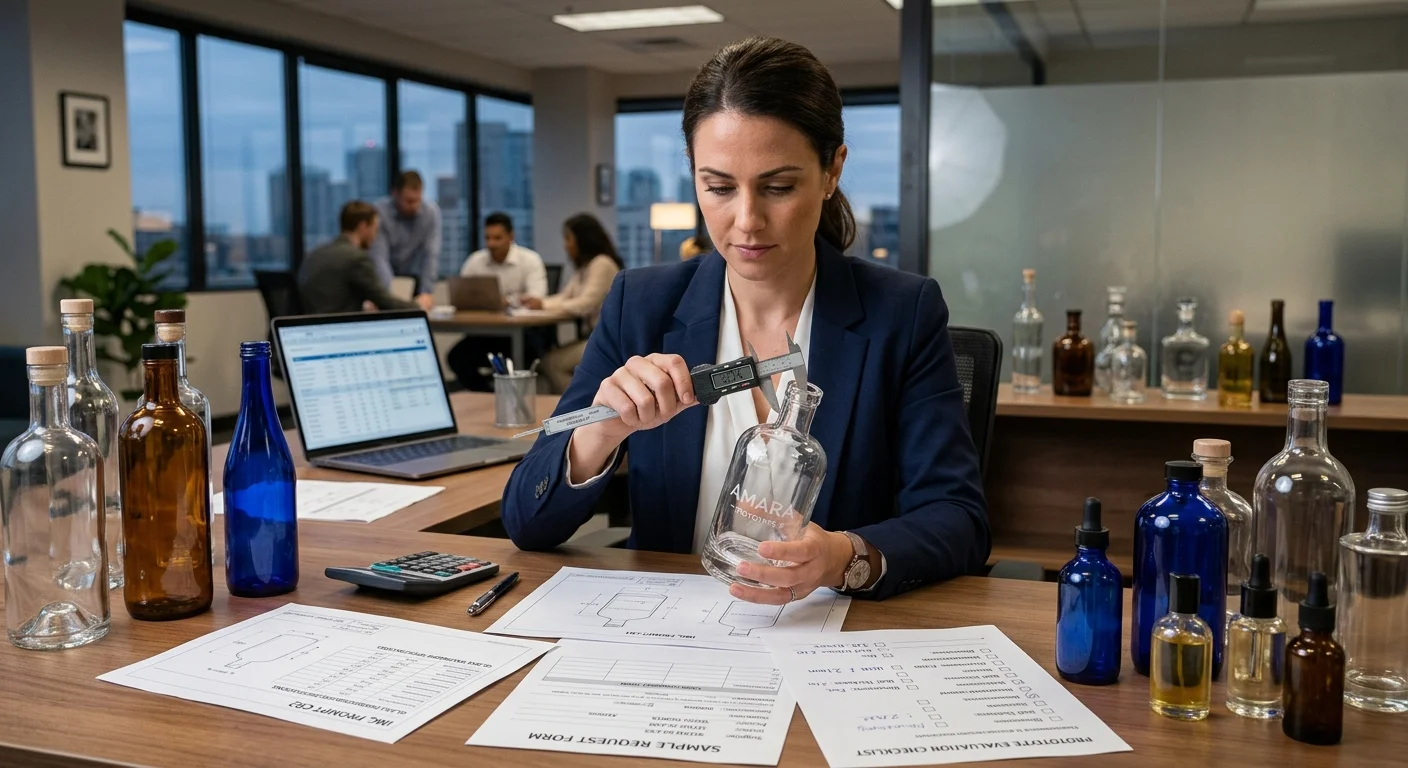
Samples don’t protect you. How you request them does.
Most buyers treat sampling like a formality — submit a rough brief, wait, approve whatever shows up. Professional procurement teams treat it like a contract negotiation. Every detail gets defined upfront. Every deviation gets documented. Every revision round is tracked against a clear standard.
Here’s how that process works.
Submit the Right Files or Expect the Wrong Samples
Your custom glassware manufacturer can only build what you give them. Vague references and mood board screenshots produce vague prototypes. It’s that simple. Send files in these formats:
- AI vector files for all surface print artwork — logos, label areas, color specs in Pantone codes
- 3D CAD drawings (.STP or .IGS format) for custom bottle shapes — include dimensional tolerances on every critical measurement
- PDF spec sheet covering: total height, body diameter, neck finish diameter, wall thickness target, base design, and weight range
Working from an existing bottle shape? Include physical measurements — not estimated ones. A 2mm variance in the neck finish diameter can mean your closures don’t seal. That’s not a factory problem. That’s a spec problem you created at the start.
What a Realistic Sampling Timeline Looks Like
For most glass bottle production facilities, standard prototyping runs 15–25 days from confirmed specs. Mold fabrication for a custom shape adds another 20–30 days on top of that.
Build two revision rounds into your timeline before finalizing anything. One round is optimistic. Three rounds means your initial spec was incomplete. Two rounds is the professional baseline.
A glass bottle factory quotes you a 7-day sample turnaround on a custom mold shape? Push back. That timeline skips steps that exist for a reason.
How to Evaluate What Arrives
Your samples land. Don’t just look at them. Measure them.
Run these checks before approving any batch move to production:
- Weight tolerance: ±5% of the specified gram weight per unit
- Wall thickness uniformity: use a digital caliper — variance above 0.3mm at any single point is a flag
- Neck/opening diameter: measure against your closure spec, not the design drawing alone
- Surface treatment adhesion: for custom printed glassware with silk-screen or frosted finishes, run a cross-hatch tape test (ASTM D3359 standard) — ink or coating should show zero peeling
- Base stability: set 10 samples on a flat surface — any rocking or lean points to mold inconsistency
Record every measurement. Send the data — not just subjective feedback — back to your manufacturer. Specific numbers speed up the next revision round. They also cut out the interpretation gaps that cost you weeks. Sampling done this way isn’t slower. It’s how professional buyers avoid paying for full production runs of something that was never quite right.
Checklist: 20 Questions to Ask Before Signing with Any Custom Glassware Manufacturer
Every bad supplier relationship starts the same way. Too few questions asked before the contract was signed. Use this checklist before you commit. It covers five areas where most custom glassware partnerships fall apart — production capability, quality control, lead times, pricing structure, and scalability. Print it. Bring it to every factory call.
Production Capability
- Do you own your furnaces and molds, or do you subcontract any part of production?
- What glass forming processes do you operate — blow-blow, press-blow, or both?
- What surface treatments can you handle in-house? Think frosting, silk-screen, electroplating, and color spraying.
- What is your minimum order quantity for custom molds versus stock shapes?
- Can you share a portfolio of custom bottle shapes you’ve produced in the last 12 months?
Quality Control
- What certifications do you hold — ISO 9001, FDA, LFGB, BSCI?
- Can you provide third-party test reports from SGS or Intertek?
- What is your acceptable defect rate per production batch? How do you measure it?
- Do you have an in-house QC team, or is inspection handled externally?
- A shipment arrives with quality issues — what’s your resolution process?
Lead Times & Delivery
- What is your standard production lead time after samples are approved?
- How long does mold fabrication take for a fully custom bottle shape?
- What ports do you ship from? What are the average freight timelines to our target market?
- Did you face any major production delays in the past year? What caused them?
Pricing Structure
- What’s included in your quoted unit price — mold costs, packaging, palletizing?
- Are tooling and mold fees one-time or recurring per order?
- At what volume thresholds do unit prices drop?
Scalability & Partnership
- Our order volume doubles within 12 months. Can your facility absorb that without stretching lead times?
- Do you offer a dedicated account manager for ongoing clients?
- Walk us through your sampling revision process. How many rounds are included before extra fees kick in?
Still sorting through these answers? Talk to our custom glassware consultants. We’ll go through every question with you and send a quote built around your actual specs — not a generic price sheet.

Conclusion
Picking the right custom glassware manufacturer isn’t just a procurement call. It’s a brand decision that shapes your reputation over time. This guide has covered the key factors to consider when selecting a custom glassware manufacturer—from verifying quality standards and customization capabilities to ensuring compliance, reliable lead times, and responsive service. Choosing the right partner is critical to getting glassware that aligns with your brand, product needs, and business goals.
As a professional glassware factory, we offer comprehensive custom solutions, strict quality control, and full compliance with global standards, along with OEM/ODM support and competitive bulk pricing. Let TP Glass Bottle Manufacturer be your reliable partner for all your custom glassware needs.