

Honey is a natural, perishable product that requires proper storage to maintain its freshness, flavor, and quality over time. The right honey container not only protects honey from moisture, air, and light—factors that can degrade its taste and texture—but also ensures it remains safe for consumption and easy to handle. With a variety of materials, sizes, and designs available on the market, it’s easy to be unsure of which option best fits your specific needs. This complete buying guide is designed to break down all the key considerations when shopping for honey containers, helping you make an informed decision that aligns with your usage, budget, and goals.
Table of Contents
Glass vs. Plastic Honey Containers: Which Is Right for Your Business?
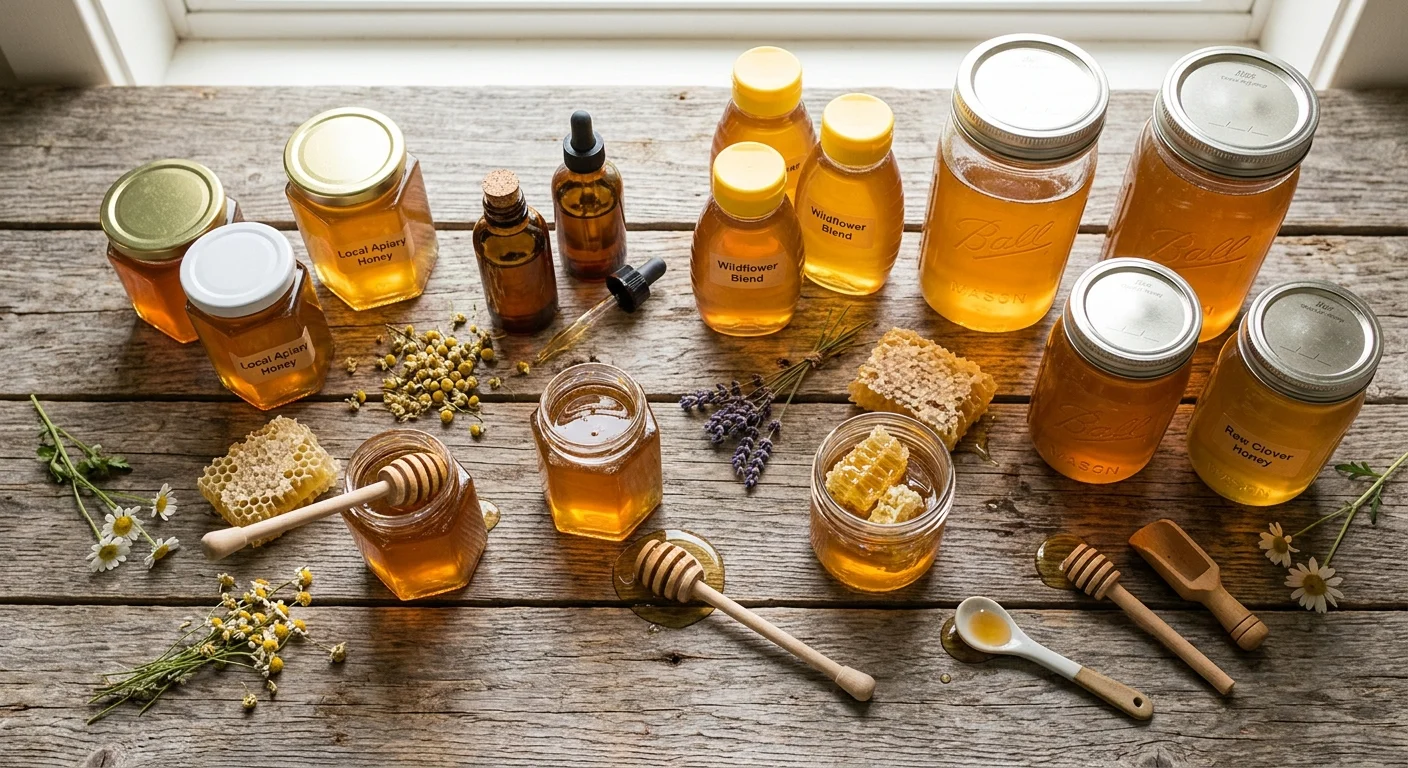
The container you choose tells a story before anyone tastes a single drop.
Glass and plastic both have a real place in the honey industry. But they serve different businesses, different customers, and different price points. Know the difference early. It saves you from a costly mistake down the road.
The Case for Glass: Purity, Presentation, and Premium Positioning
Glass is chemically inert. Most buyers don’t fully appreciate what that means at first.
Plastic can leach polymers into your product over time. Glass does none of that. It absorbs no flavors. It carries nothing over from the last batch. What goes in comes out clean — the same floral notes, the same viscosity, the same golden color your bees produced.
Glass honey jars are the natural choice for:
- Artisan and boutique honey brands where flavor integrity is non-negotiable
- Gift packaging and seasonal collections where visual appeal drives purchase decisions
- High-end retail and farmers’ markets where customers read labels and pay a premium for quality cues
- Export and specialty products like raw, monofloral, or infused honey that command higher price points
There’s also a strong visual case. Amber glass honey jars pull double duty. They block UV light to protect light-sensitive honey. They also show off that deep, warm color that signals quality on a shelf. A glass honey pot with a cork lid or a polished metal screw cap sends a clear message: craftsmanship. Plastic can’t match that.
Brands investing in honey bottle packaging meant to be kept, displayed, or gifted — glass is the clear answer.
The Case for Plastic: Efficiency, Safety, and Scalability
Plastic isn’t a compromise. For the right operation, it’s the smarter call.
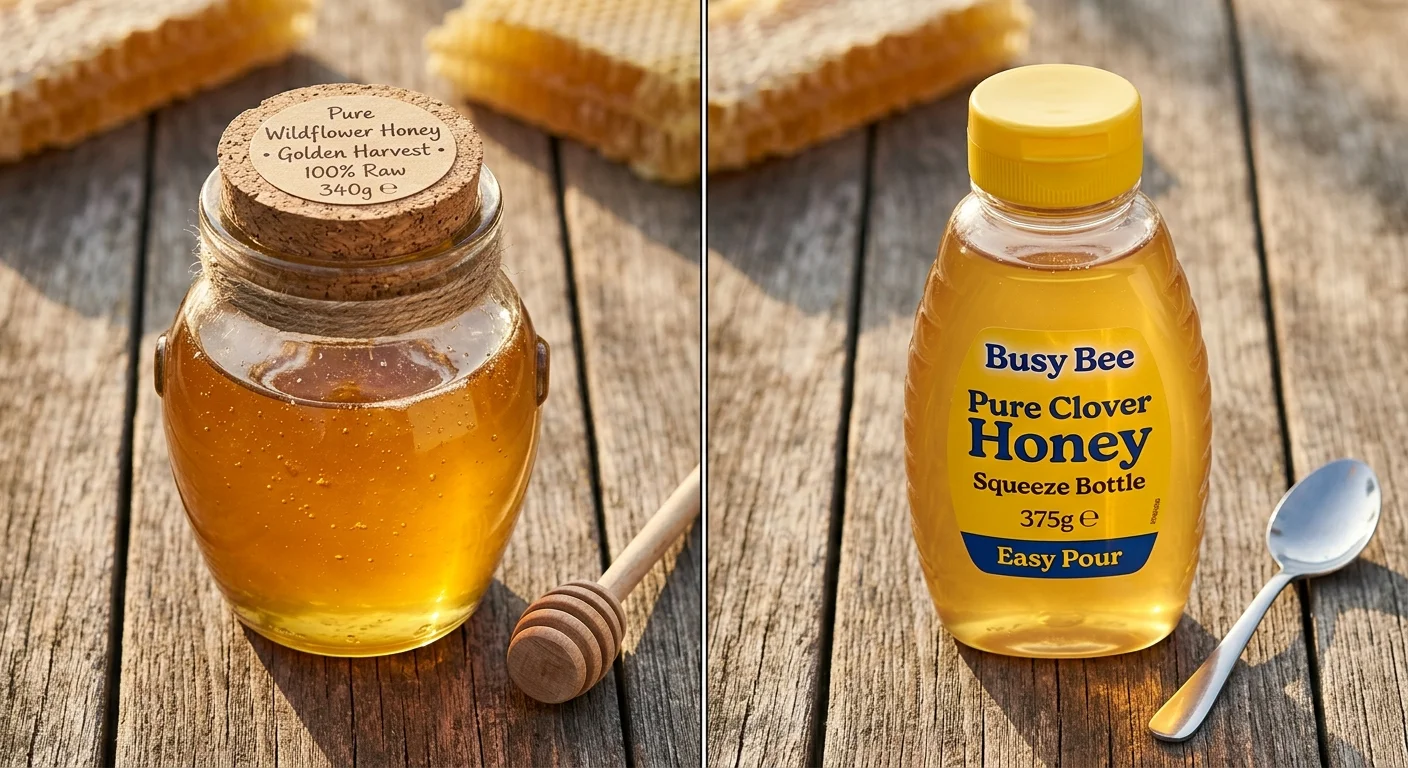
Food grade honey jars made from BPA-free PET or HDPE are shatter-resistant. They’re much lighter than glass. They cost less per unit at wholesale volume. Shipping large quantities? Weight alone hits your freight costs hard across thousands of orders. Plastic keeps that number down.
Honey squeeze bottles are the best example of plastic doing something glass flat-out can’t. The soft, squeezable body gives customers precise portion control. That makes them ideal for food service accounts, breakfast condiment stations, and households with children. The functionality is built into the format itself — not bolted on.
Plastic is also the practical choice for:
- High-volume commercial production where breakage during filling or transit is a real operational risk
- Outdoor markets and events where glass is a safety concern
- Private-label startups managing tight margins on their first bulk run
- Squeeze-and-drizzle formats where ease of use is a key selling point
Side-by-Side: Quick Decision Reference
| Factor | Glass | Plastic |
|---|---|---|
| Flavor neutrality | ✅ Excellent | ⚠️ Good (food-grade only) |
| Premium presentation | ✅ High | ❌ Limited |
| Shatter resistance | ❌ Fragile | ✅ Durable |
| Weight & shipping cost | ❌ Heavier | ✅ Lighter |
| Squeeze functionality | ❌ Not applicable | ✅ Purpose-built |
| Gift & retail appeal | ✅ Strong | ⚠️ Moderate |
| Wholesale unit cost | ⚠️ Higher | ✅ Lower |
Most established honey businesses don’t lock into one format. They run both. Glass covers the premium retail line. Plastic honey squeeze bottles handle food service and everyday ranges.
The real question isn’t which material is better. It’s which material fits the product you’re selling — and the customer buying it.
Honey Container Sizes Guide: Match Capacity to Your Use Case
Size is where most buyers make their first — and most expensive — miscalculation.
Not because the options are confusing. The right size depends on who you’re selling to and how they’ll use the honey. A 5-gallon bucket works perfectly for a commercial bakery. That same bucket is a complete disaster for a farmers’ market stall. A delicate 2oz jar looks stunning in a gift box. It makes zero economic sense for everyday retail.
Here’s how to match capacity to your actual use case.
Small Containers (2oz / 4oz / 8oz): The High-Margin Play
Small jars punch well above their weight in profit.
A 2oz glass honey pot retails at a price customers find accessible. But your margin per ounce runs much higher than on larger formats. That’s the math that makes small containers so valuable for the right business.
These sizes are built for:
- Wedding favors and seasonal gift sets — a 2oz hex jar with a ribbon and kraft label is a complete product in itself
- Tasting flights and sampler collections — let customers try three single-origin varieties before committing to a full jar
- Holiday gift boxes — small honey jar with lid formats stack cleanly, photograph well, and support premium gift pricing
- Trial units for new product launches — lower the barrier to purchase and get your honey into more hands faster
The logic is straightforward. Customers will pay a higher per-ounce price for something small, beautiful, and easy to gift. That’s where honey bottle packaging becomes a marketing tool — not just a functional vessel.
Mid-Size Containers (12oz / 1lb / 2lb): The Retail Workhorse
Walk into any well-stocked farmers’ market or independent grocery. The jars moving fastest off the shelf are almost always in the 1lb range.
Mid-size food grade honey jars hit the sweet spot between perceived value and practical usability. A 1lb jar lasts a household around four to six weeks of regular use. That’s long enough to feel like good value — and short enough to drive repeat purchases. That repeat-purchase cycle is what builds a loyal customer base.
These formats also work hard on a shelf. A row of 12oz amber glass honey jars at eye level creates real visual impact. The weight feels solid in a customer’s hand. The price sits in a range that needs no justification.
Mid-size containers are the core of most retail honey ranges — and for good reason.
Large Containers (Quart / 5lb / 1–5 Gallon): The Commercial Logic
At high volume, the unit economics shift in your favor.
Restaurants, bakeries, and honey re-packers don’t need presentation-ready jars. They need reliable, food-safe vessels in quantity — at a cost that keeps their margins intact. A honey dispenser container or bulk pail format delivers exactly that.
Beekeeping supplies containers at quart size and above are the standard choice for:
- Food service accounts — cafés, breakfast menus, catering operations
- Artisan bakeries using honey as a core ingredient
- Secondary processors buying raw honey in bulk for repackaging into branded retail jars
Larger formats cut per-unit cost fast. For mason jars for honey at wholesale volume, moving up from 1lb to 5lb can reduce your container cost per ounce by 30–40% — depending on supplier and order quantity.
The practical rule: Match your smallest container to your highest-margin channel. Match your largest container to your highest-volume buyer. Most operations run two or three sizes in parallel rather than locking into one. You get the flexibility to serve retail customers and commercial accounts — without stretching inventory too thin.
Honey Jars Wholesale: How to Buy in Bulk and Save
Bulk buying is where the real numbers start to shift.
Once you move past the “testing a few designs” stage, your container cost becomes a real line on your profit sheet. Buying 50 jars vs. 500 isn’t just a bigger shipment. It’s a different price structure, a different supplier relationship, and a different conversation.
Understanding the Price Tier Logic
Most honey jars wholesale suppliers use tiered pricing. Order more, pay less per unit. Simple idea. But the price drops between tiers can be sharp.
A 1lb amber glass honey jar might cost $1.20 per unit at 50 pieces. At 500 units, that same jar drops to $0.75. At 2,000 units, you could be paying $0.52. That’s a 57% reduction in container cost per jar. Across a full production season, those savings stack up fast.
So before you lock in a size or style, ask your supplier for the full price ladder. Most will share it. If they won’t, that tells you something worth knowing.
MOQ — minimum order quantity — is the number that controls your decision. Some suppliers set MOQ at 100 units. Others won’t talk below 1,000. For smaller beekeeping operations scaling up, those thresholds matter.
Look for suppliers with flexible entry points on bulk honey containers — especially if you’re sourcing multiple formats at once. Some suppliers let you combine SKUs toward a shared MOQ. That gives you real flexibility without forcing you to over-order one jar style.
How to Evaluate a Wholesale Supplier
Not every Glass Bottle Supplier is built for honey. That distinction deserves your attention.
A general-purpose glass manufacturer can produce jars. A supplier who specializes in honey packaging containers knows the details: neck widths that fit standard honey fillers, lid tolerances that seal tight against crystallization, and jar shapes — hex, round, honeycomb — that sell well in both retail and gift markets.
Shortlisting glass honey jars suppliers? Run through this checklist:
- Product catalog transparency — Check for clear specs. Dimensions, weight, glass thickness, and lid compatibility should all be listed upfront. No need to ask twice.
- Food safety certification — All jars must meet food-grade standards. Ask about BPA-free closures and compliance with FDA or equivalent food-contact regulations.
- Sample availability — Any solid wholesale source will send samples before you commit to volume. No samples on offer? Move on.
- Lead times and stock reliability — A great price means nothing if jars show up two weeks after your harvest is ready to bottle.
- Custom labeling support — Building a brand? Check whether the supplier offers label-friendly surfaces or custom embossing at volume.
Search Smarter to Source Better
The keywords you use in your search make a real difference in what you find.
Broad searches like “honey jars” pull up consumer retail listings — individual units, decorative pieces, nothing close to wholesale pricing. Narrow it down to honey jars wholesale, bulk honey containers, or glass honey jars supplier. The results shift toward manufacturers, distributors, and trade-facing catalog pages.
That’s where the right conversations start.
The best wholesale relationships go beyond transactions. They’re built on clear specs, reliable timelines, and a supplier who treats your container as part of your product — not just something to fill.
Honey Containers for Sale — Answers for Beekeepers and Honey Brands
You’ve read every comparison chart and product spec sheet. Yet most beekeepers and honey brands still land on the same three questions. The same doubts. The same small gap between knowing the options and placing an order.
These questions deserve real answers.
How Do You Stop Honey from Crystallizing in the Container?
Crystallization is natural. It’s not a quality defect — it’s chemistry. But your container choice does affect how fast it happens and how easy it is to manage.
Two factors matter most: moisture control and storage temperature.
Food grade honey jars with airtight lids — especially those with inner liner seals — cut down moisture getting in. Moisture speeds up crystallization. So airtight matters. Store sealed jars away from temperature swings. A cool, stable environment (around 57°F / 14°C) slows the process down.
Worried customers ask about crystallized honey a lot. For them, a honey squeeze bottle in soft plastic is a practical fix. Gentle hand pressure breaks up the granules without any reheating needed. For glass containers, a short warm-water bath brings the honey back to flowing consistency — no flavor damage.
The container won’t stop crystallization. The right container just makes it much less of a headache.
What’s the Most Cost-Effective Size for Small-Batch Producers?
The 1lb mason jar for honey is where the numbers make sense at small scale.
It holds enough volume to support a fair retail price. It ships without the fragility issues you get with smaller novelty jars. The per-unit cost at modest wholesale quantities — 100 to 250 pieces — stays low enough to protect your margin. No large upfront commitment needed.
Starting out in your first or second bottling season? A mixed run of 1lb and 8oz honey packaging containers gives you room to move across retail and gift channels. You stay flexible without tying up capital in one format.
Ready to compare specific formats and request samples?
Conclusion
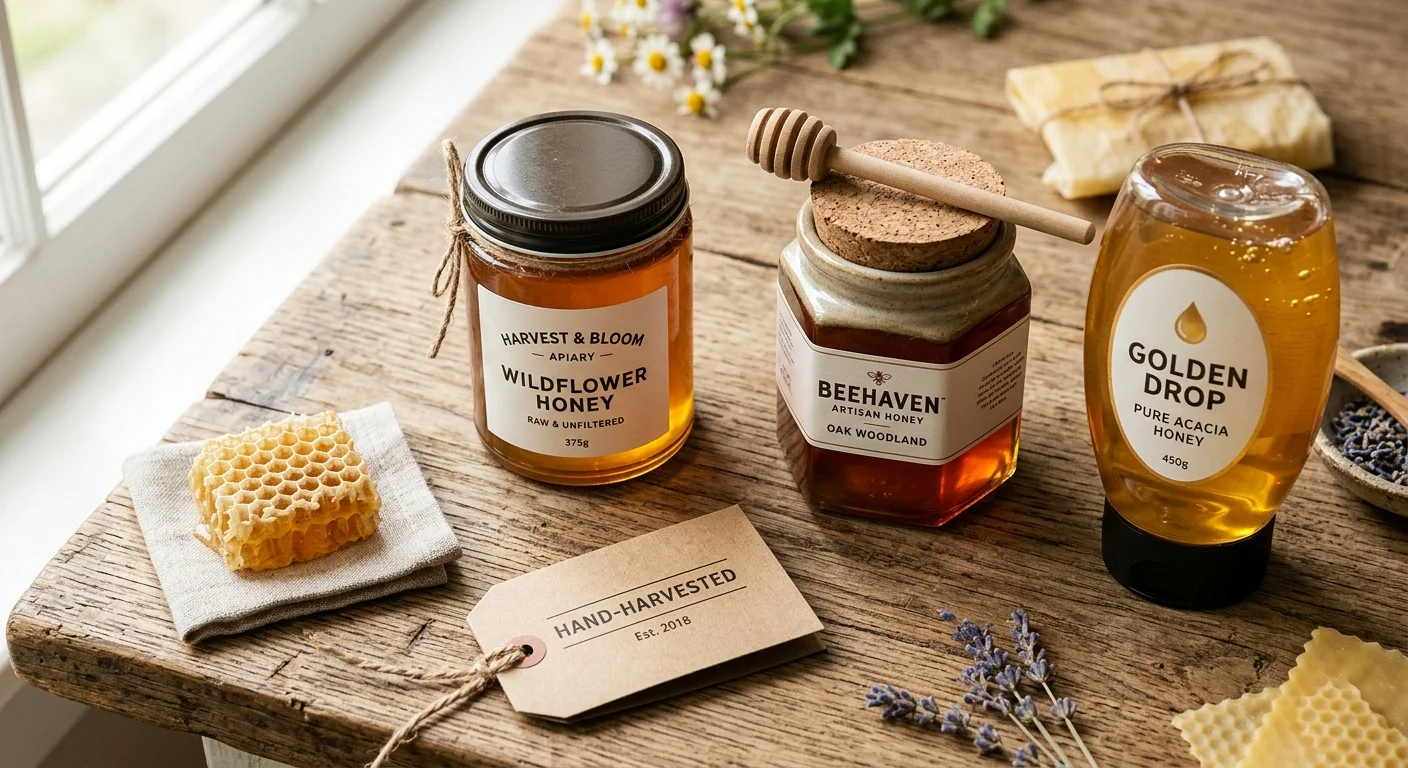
Choosing the right honey container comes down to understanding your specific needs—whether it’s for commercial packaging, home storage, or gifting—along with key factors like material durability, sealing performance, size compatibility, and cost-effectiveness. We’ve covered the pros and cons of different container types, how to match sizes to your usage, and what to look for to ensure your honey stays fresh and appealing.
At TP Glass Bottle Manufacturer, our glass bottles are designed with tight, leak-proof seals to lock in freshness, available in a range of sizes and customizable designs to fit your branding needs, and manufactured with strict quality control to ensure durability and safety. Whether you need bulk orders for retail or custom-shaped bottles to make your honey stand out, we’re here to provide the perfect glass container solution to complement your product and help you succeed in the market.