

Glass packaging has long been a reliable choice across industries, from food and beverage to cosmetics and pharmaceuticals, due to its inert nature, recyclability, and ability to preserve product quality. While traditional glass bottles have served their purpose well, innovations in glass manufacturing have led to the development of lightweight alternatives. These lightweight glass bottles are quickly gaining momentum, emerging as a front-runner in shaping the future of glass packaging. This article will explore the reasons behind their rising popularity, examining how they address key industry challenges and why they are positioned to lead the way forward.
Table of Contents
What “Light Weighting” Really Means in Modern Glass Manufacturing
Here’s a distinction the industry often blurs: light weighting and right weighting are not the same thing. Mixing up the two is where a lot of packaging decisions go wrong.
Light weighting is the clearer concept. It’s the engineering process of reducing the total glass mass of a bottle while keeping its structure intact. Modern manufacturing benchmarks put this at a 20–30% weight reduction compared to traditional bottle equivalents. You still get full pressure tolerance, drop resistance, and seal performance — the things brands and supply chains rely on.
Right weighting goes further. It’s about finding the best weight for a bottle’s specific job — not just the lowest number possible. A wine bottle heading to premium retail faces different structural demands than a mass-market water bottle. Right weighting looks at:
Fill type and pressure — carbonated beverages need stronger walls than still liquids
Distribution stress — how far the bottle ships, how it’s stacked, and how rough the handling gets
Consumer perception — weight still signals quality in some categories, and cutting too much glass can hurt a brand’s image
Regulatory requirements — certain markets set minimum thickness standards that act as a hard floor
The engineering tools behind this shift are worth knowing. Glass manufacturers run finite element analysis (FEA) to map stress points across the full bottle shape before cutting a single mold. Paired with precision-controlled blow-and-blow or press-and-blow forming, this lets manufacturers vary wall thickness on purpose — thicker where the load hits hardest, thinner where it doesn’t need to be.
The result is a Lightweight Glass Bottle that meets or beats traditional weight specs. Not in spite of using less material, but because that material is placed exactly where it counts.
That’s the real story behind the numbers. Less glass, yes. But smarter glass.
The Sustainability Case: Why Lightweight Glass Outperforms Heavy Glass on the Environment
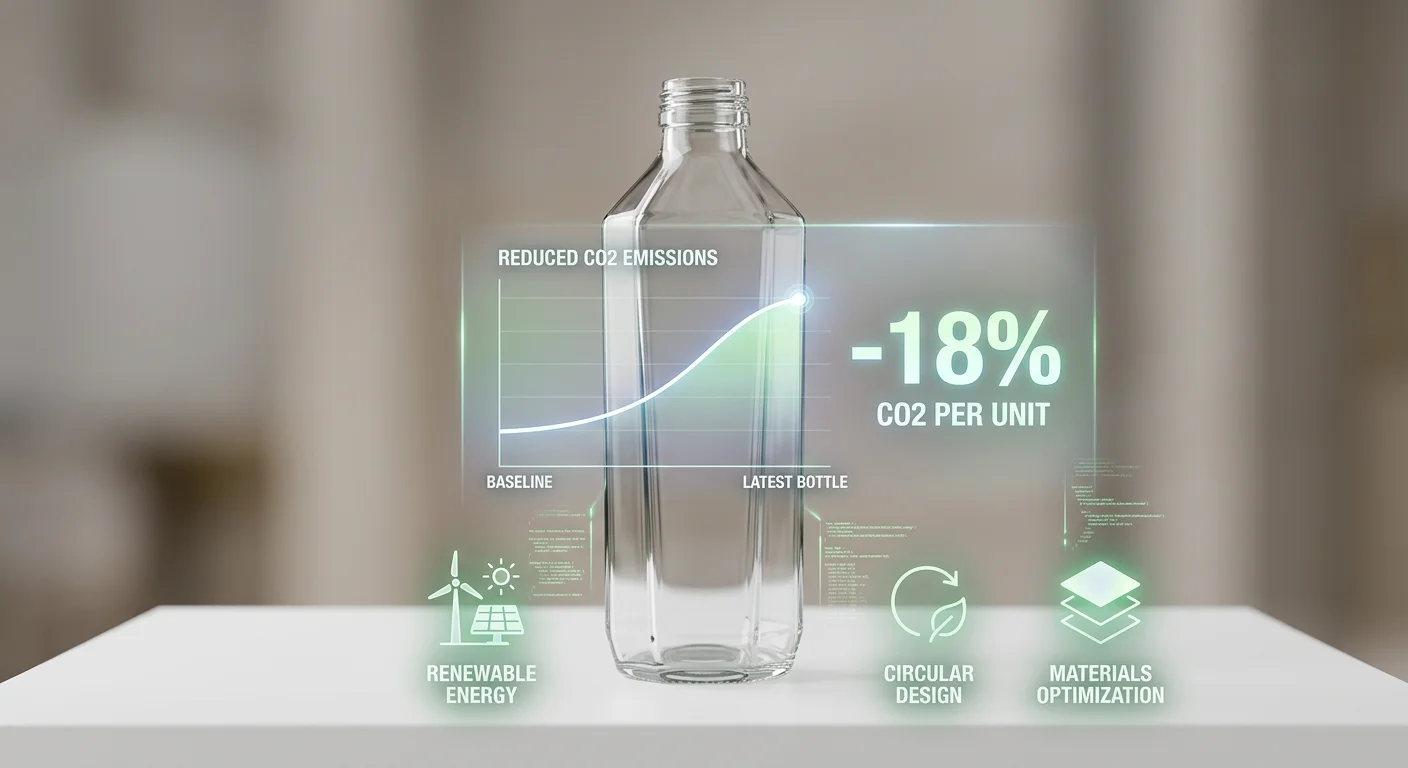
The numbers don’t lie. In packaging, the data rarely favors anyone — but lightweight glass bottles are a clear exception.
Start with carbon. Remove a kilogram of glass from a bottle, and CO₂ emissions drop across the board — at the furnace, in transit, all the way down the supply chain. Industry figures show 10–20% emissions reduction per unit when a bottle sheds 20–30% of its mass. That sounds small. Scale it up, and the picture changes fast. A mid-size beverage brand running 50 million units a year isn’t trimming a little carbon. It’s cutting thousands of tonnes of CO₂ before a single bottle hits the shelf.
Transportation makes the math even stronger. Lighter bottles fill lighter pallets. Lighter pallets pack more units per truck. More units per truck means fewer trucks on the road. Logistics data shows a 10% drop in packaging weight produces 5–7% fuel savings across standard distribution routes. For brands shipping across continents, those savings aren’t theoretical. They show up in freight invoices and scope 3 emissions reports.
The Cullet Advantage: How Recycled Glass Multiplies the Gain
This is where lightweight glass pulls ahead of plastics and aluminum in a way neither can match.
Glass production uses cullet — recycled glass — and the energy impact is real. Every 10% increase in cullet content cuts furnace energy demand by 2–3%. The reason is simple: melting recycled glass needs far less heat than processing raw silica, limestone, and soda ash from the ground up.
A lightweight glass bottle that enters the recycling stream doesn’t just cancel out its own production cost. It feeds back into a closed production loop where future bottles cost less energy to make. That’s not a marketing claim. It’s basic thermodynamics.
Compare that to plastic. “Recycled” PET loses quality with each processing cycle. It drifts out of the loop into lower-grade uses or ends up in landfill. Aluminum recycling performs well, but replacing loop losses means mining more bauxite — a process with a heavy extraction cost. Glass, recycled right, comes back as glass. Same quality. Same use. No downgrade.
Lifecycle Reality: Glass’s Permanent-Cycle Advantage
Lifecycle comparisons between packaging materials are often contested. But one point holds up across most assessments: glass wins on end-of-life circularity.
Glass doesn’t degrade. It doesn’t leach chemicals. It doesn’t break into microparticles that work their way into soil or waterways. A lightweight glass bottle that weighs 30% less than an older version still carries all of those properties — with a smaller production footprint behind it.
Less mass. A cleaner recycling loop. Lower freight emissions. Better recycled-content economics. For brands building sustainability commitments that need to hold up under real scrutiny, lightweight glass isn’t a trade-off. The data keeps pointing in one direction — and it points here.
Economic Drivers Pushing Brands Toward Lightweight Bottles
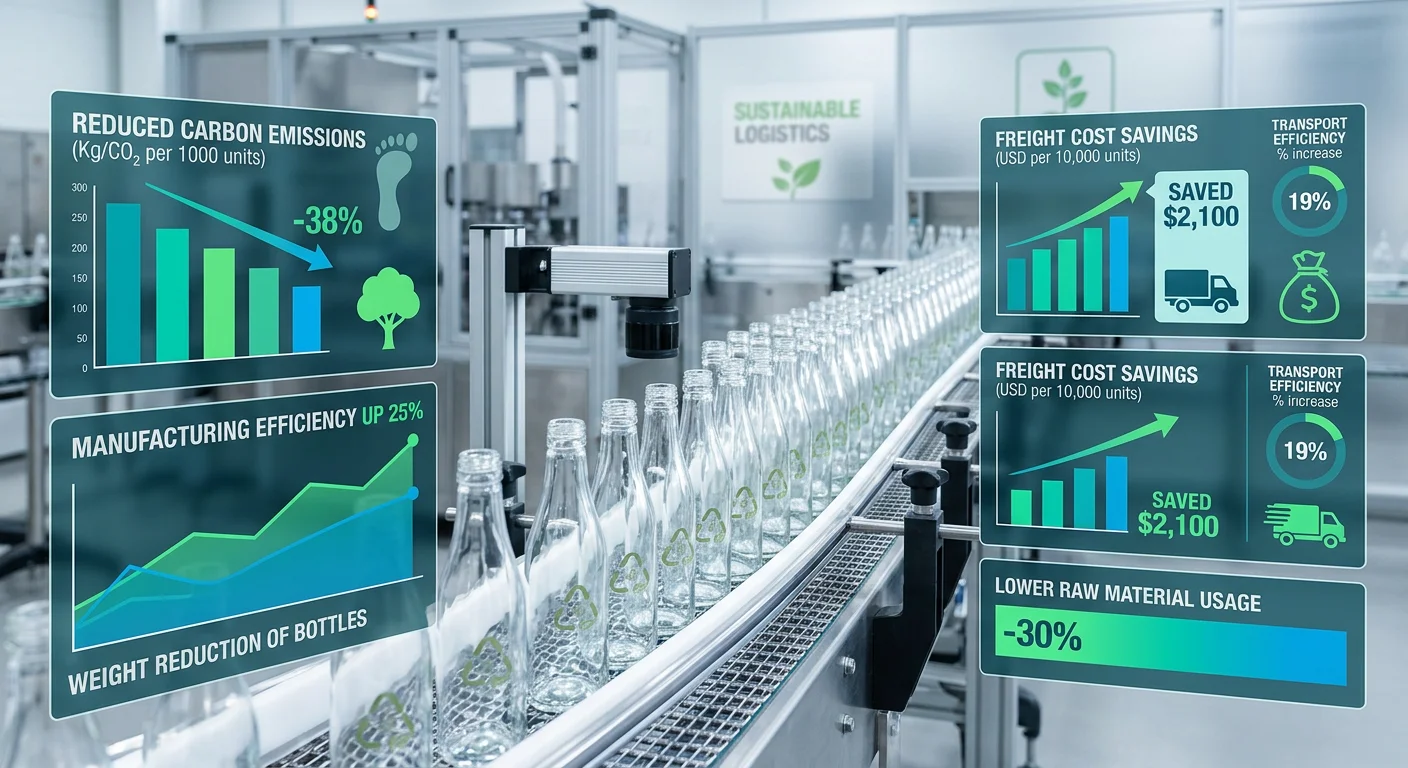
Procurement teams didn’t fall in love with lightweight glass bottles because of sustainability reports. They fell in love because the numbers worked.
The economics start at the furnace — and they build from there. Glass melts at 1,400–1,600°C. Running at those temperatures is expensive by default. Every gram of glass that doesn’t need to melt is energy that doesn’t need to be burned. A lightweight glass bottle design pulls 20–30% of the mass out of each unit. That cuts energy cost per bottle in a way you’ll see on monthly operating statements — not buried in annual sustainability disclosures.
Modern multi-gob forming machines push this further. These systems run multiple bottle formations at once from a single gob of molten glass. Each bottle uses less material. So the same gob output stretches further — more bottles per furnace cycle, more throughput per shift. For high-volume glass manufacturers producing tens of millions of units per year, that throughput gain is not small. It’s the difference between expanding capacity and ordering new equipment.
Where the Freight Math Gets Serious
Production savings are real. But for most brands, transportation is where lightweight glass packaging makes the strongest financial case.
Standard glass bottles are heavy. Stack them on pallets, load those pallets into containers, ship them across a continent — the weight adds up fast. A lightweight glass bottle running 20–30% lighter than a traditional equivalent changes the freight equation at every step:
More units fit per pallet at the same weight limit
More pallets load per truck before hitting the axle ceiling
The result: fewer shipments per equivalent volume of product
Industry freight data puts the gain at 5–7% fuel savings for every 10% reduction in packaging weight across standard distribution routes. For brands managing transcontinental supply chains, that percentage shows up as real dollars on real invoices — not projected savings in a slide deck.
Run the pallet-level math and it gets clearer. A brand shipping 40-foot containers and switching to a lightweight format can often fit an additional full pallet layer per load. Scale that across hundreds of container movements per year, and the freight reduction covers a solid share of any reformulation or tooling investment within the first year.
The Cost Case Brands Are Making Internally
This is what makes lightweight glass bottles an easier internal sell than most packaging upgrades. The cost argument doesn’t rely on commodity price forecasts or carbon credit valuations. It’s logistics math. It’s energy math. It’s production throughput math.
Sustainability goals opened the conversation. But what’s closing the business case — what’s moving this from pilot program to full production commitment — is that lighter glass costs less to make, less to ship, and less to store. The economics don’t need a sustainability headline to hold up. They hold up on their own.
Industry Applications Leading Lightweight Glass Adoption
Lightweight glass adoption isn’t spreading at the same pace across industries. Some segments are moving fast. Others are pulling back — on purpose, and for reasons that make sense once you see what’s at stake in each category.
Beverages: Where the Numbers Move Fastest
The beverage sector drives the largest volume of lightweight glass bottle use worldwide. The breakdown by segment makes it clear why.
Water and carbonated soft drinks moved first. The case was simple: high production volumes, price-sensitive buyers, and distribution networks spread across huge distances. A small weight drop per unit, multiplied across billions of bottles, adds up to a real cost and freight advantage. Carbonated formats needed careful engineering — thinner walls still have to hold internal pressure — but modern FEA modeling handled that without hurting performance.
Beer came next, though more selectively. Mid-tier and economy beer brands shifted to lighter formats as packaging cost pressure grew. The structural demands are manageable. Brand risk was the bigger concern — and for most mainstream beer labels, lighter packaging cleared the consumer perception bar without much pushback.
Wine is different. And this is where things get complicated.
The Premiumization Paradox
Premium wine producers know something that goes against common sense: in their category, a heavier bottle still drives more sales.
Buyers link bottle weight to quality. It’s not logical. It says nothing about the wine inside. But it’s real, and decades of consumer research confirm it. A 750ml Bordeaux-style bottle at 600g sends a signal that a 450g bottle doesn’t — even when the wine is identical. For brands at the premium end, cutting glass weight isn’t a smart move. It’s a brand risk.
That doesn’t mean wine has walked away from lightweight glass. Mid-tier and everyday wine labels have shifted to lighter formats at scale — especially in export markets where freight costs hit hard. But premium and ultra-premium producers are holding their weight on purpose.
So lightweight glass bottle design in beverages isn’t one decision. It’s a segmentation decision.
Pharmaceutical and Specialty Food: A Different Set of Requirements
Pharmaceutical glass packaging works under stricter rules than beverages. Regulatory standards — USP and EP glass container requirements, in particular — set minimum barrier performance and chemical resistance levels. These can’t be sacrificed for weight savings.
What has changed is manufacturing precision. Modern lightweight pharmaceutical glass vials and bottles now meet those regulatory thresholds at lower mass. The core properties glass delivers — no gas permeability, zero chemical leaching, full compatibility with sterilization — stay intact. The glass is simply engineered more tightly to hit those specs without extra material.
Specialty food packaging follows the same path. Sauces, condiments, and preserved foods use glass for those same inert barrier qualities. Lighter formats have gained ground in this space — especially in private-label and mass-market food categories where cost efficiency shapes packaging choices more than brand image does.
The common thread across all these sectors: lightweight glass bottles move fastest where precise engineering can cut mass without cutting performance. They stall where consumer perception or regulatory minimums draw a hard line on how light is light enough.
Consumer Perception and Brand Alignment With Lightweight Glass

Consumers don’t read engineering specs. They pick up a bottle, feel it, and decide.
That tactile moment carries more weight than most packaging engineers want to admit. Survey data shows that consumers link glass — over plastic and aluminum — with better taste, higher safety standards, and a real sense of product quality. In blind comparisons, beverages stored in glass score higher on perceived freshness and purity. That holds true even when the liquid is the same as what’s sitting in a plastic container. The bottle is doing brand work before anyone takes a sip.
The health and safety dimension runs deep. Concerns around BPA migration, plastic leaching, and aluminum linings have pushed a clear segment of buyers toward glass by default. Not because they’ve read the studies. Because glass feels clean in a way other materials don’t. That perception is a brand asset, and smart packaging teams know it.
Where Sustainability Becomes a Purchase Driver
ESG reporting stopped being optional, and that changed everything. Brands facing mandatory scope 3 emissions disclosures needed packaging with real, auditable sustainability credentials. Recyclability claims that fell apart under scrutiny weren’t going to cut it. Lightweight glass bottles fit that requirement. They cut upstream carbon, ship with better load efficiency, and feed back into a closed recycling loop that regulators and investors can verify.
That compliance pressure is reshaping purchasing decisions at the brand level. It’s less about consumer-facing green messaging. It’s more about what holds up in an annual report.
Major brands have made that commitment public:
Heineken set formal targets to reduce glass packaging weight across its global bottle portfolio.
Coca-Cola and Nestlé Waters both built lightweight packaging metrics into their broader sustainability roadmaps — specific, reported, and tied to supply chain accountability.
The Alignment Point Brands Are Reaching
A few forces are coming together here. Consumers prefer glass for trust and quality reasons. ESG pressure is pushing brands toward lighter, lower-carbon packaging. And the lightweight glass bottle format satisfies both — no trade-off required.
The bottle gets lighter. The brand case gets stronger.
Conclusion
Lightweight glass bottles are defining the future of glass packaging, balancing glass’s classic benefits—product preservation, inertness, recyclability—with modern demands for sustainability, cost-efficiency and practicality. Solving key industry challenges like lower carbon footprints and transportation costs, they are the top choice for forward-thinking brands.
At TP Glass Bottle Manufacturer, we are at the forefront of this innovation, specializing in high-quality lightweight glass bottles that meet strict quality standards while aligning with sustainable goals. Our customizable solutions cater to diverse industry needs, helping brands embrace the future of packaging without compromising on product integrity. Choose TP Glass Bottle Manufacturer as your partner to leverage lightweight glass technology and stay ahead in the evolving packaging landscape.