
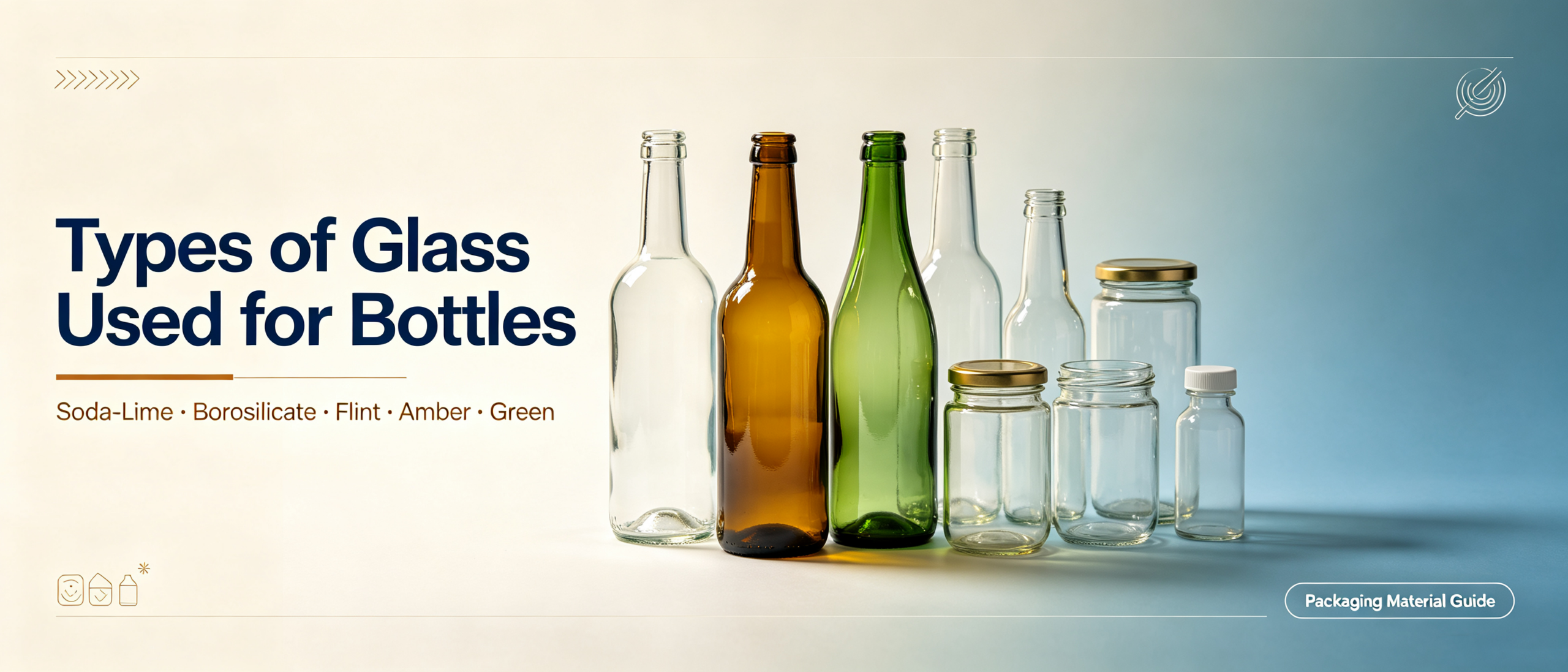
Glass bottles are made from different types of glass, and the choice affects their strength, heat resistance, appearance, weight, and cost. For beverage, liquor, food, and pharmaceutical packaging, choosing the right glass is an important part of bottle design and production.
The most common glass used for bottles is soda-lime glass, while borosilicate glass is selected when higher thermal and chemical resistance is required. There are also different glass colors and formulations used for specific packaging needs. In this guide, we’ll look at the main types of glass used for bottles and when each one makes sense.
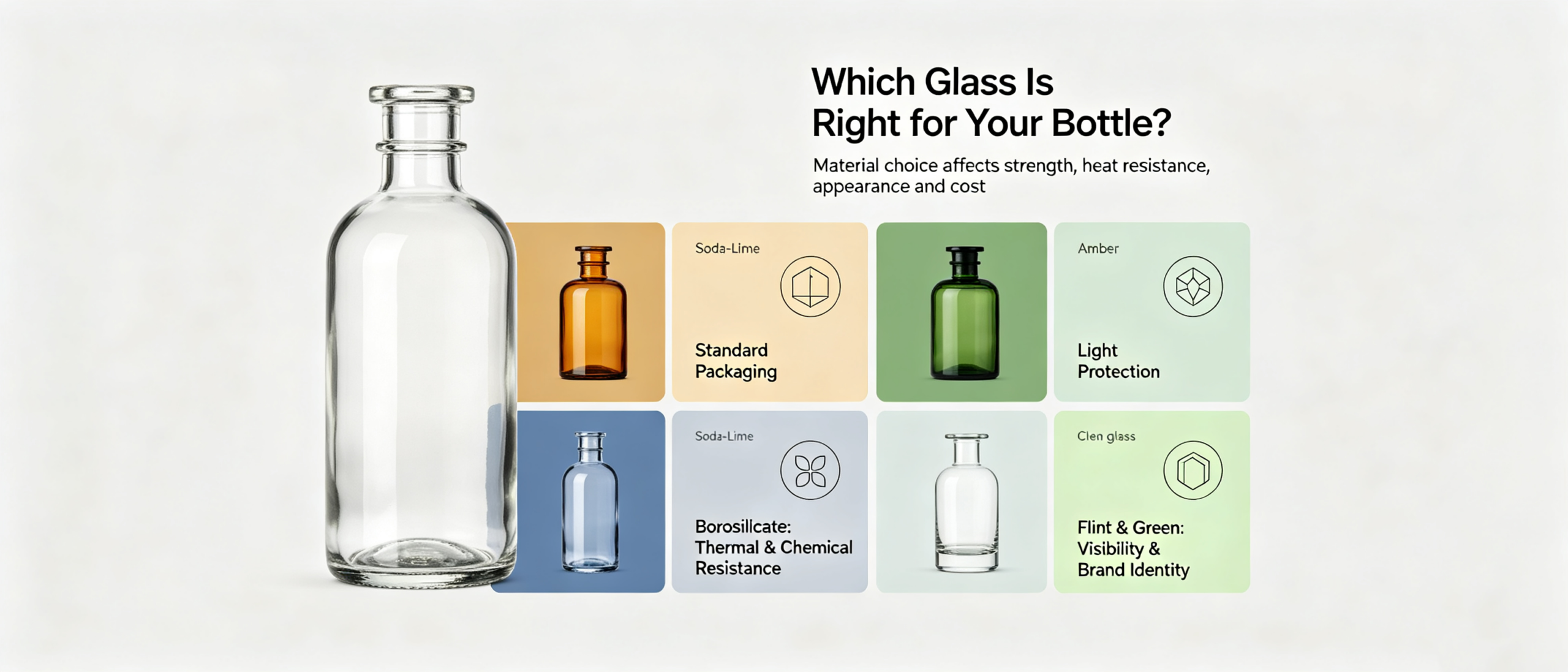
Table of Contents
Soda-Lime Glass
Soda-lime glass is the most widely used type of glass for commercial bottles and jars. It offers a practical balance of durability, manufacturability, appearance, and cost.
Most everyday beverage bottles, liquor bottles, beer bottles, food jars, and many cosmetic containers are made from soda-lime glass.
Why is soda-lime glass widely used?
It works well with high-volume manufacturing and can be produced in a wide range of bottle shapes, sizes, colors, and neck finishes.
Typical advantages include:
- Good mechanical strength
- Suitable for mass production
- Available in clear and colored glass
- Wide range of bottle shapes and sizes
- Cost-effective for commercial packaging
For most beverage and food packaging projects, soda-lime glass is the standard starting point.
Borosilicate Glass
Borosilicate glass contains boron oxide, which gives it better resistance to thermal shock and many chemicals compared with conventional soda-lime glass.
It is commonly used when a container may experience significant temperature changes or when higher chemical resistance is important.
For example, borosilicate glass can be found in laboratory containers, pharmaceutical packaging, specialty food containers, and some premium packaging applications.
Advantages of borosilicate glass
- High thermal shock resistance
- Good chemical resistance
- Suitable for applications involving temperature changes
- Stable material for specialized packaging
However, borosilicate glass is not automatically the best choice for every bottle. For standard liquor, beer, beverage, or food packaging, soda-lime glass is often more practical because it is widely available and better suited to large-scale bottle production.
Flint Glass
Flint glass generally refers to clear, colorless glass used when product visibility and appearance are important. The transparent appearance allows customers to see the color and condition of the product inside the bottle. This makes it particularly popular for spirits, beverages, sauces, cosmetics, and other products where presentation matters.
Clear glass can also give a bottle a clean and premium appearance, especially when combined with a distinctive bottle shape or custom decoration. For liquor brands, clear flint glass is commonly used for products such as vodka, gin, tequila, and other spirits where the liquid’s color is part of the product presentation.
Amber Glass
Amber glass is a brown-colored glass commonly used for beer, pharmaceuticals, and products that need additional protection from light. The darker color can help reduce the amount of ultraviolet and visible light reaching the contents. This is particularly useful for light-sensitive products.
Amber glass bottles are widely used for:
- Beer
- Pharmaceutical products
- Certain food products
- Extracts and specialty liquids
- Some chemical products
For beer packaging, amber glass has remained popular because protecting the beer from light is an important consideration.
Green Glass
Green glass is another common choice for beverage and liquor bottles. It is strongly associated with traditional wine and certain beer packaging, but it is also used for other beverage applications.
Like other colored glass, green glass can provide some protection from light while also creating a distinctive visual identity.
For brands, color is not only a functional decision. The glass color can become part of the product’s packaging identity and help distinguish one bottle from another.
What Is the Difference Between Clear, Amber and Green Glass?
Clear, amber, and green glass are all widely used for bottles, but they create different packaging results.
| Glass type | Main advantage | Common applications |
|---|---|---|
| Clear / Flint | Product visibility and appearance | Liquor, beverages, food, cosmetics |
| Amber | Better light protection | Beer, pharmaceuticals, specialty liquids |
| Green | Appearance and some light protection | Wine, beer, beverages |
| Borosilicate | Thermal and chemical resistance | Specialty, pharmaceutical, laboratory |
The right choice depends on the product, filling process, storage conditions, appearance requirements, and target market.
Which Type of Glass Is Best for Your Bottle?
There is no single glass type that is best for every bottle.
For most standard beverage, liquor, beer, and food packaging projects, soda-lime glass is a practical choice. It supports a wide range of bottle designs and is suitable for large-scale manufacturing. Borosilicate glass becomes more relevant when the bottle needs higher thermal shock or chemical resistance.
The glass color should also be selected based on the product and branding requirements. Clear glass is useful when product visibility is important, while amber or green glass may be preferred when light protection or a specific appearance is needed.
For custom bottle development, several additional factors should be considered:
- Bottle capacity and dimensions
- Wall thickness and bottle weight
- Neck finish and closure compatibility
- Filling and processing temperature
- Required glass color
- Decoration and printing requirements
- Packaging and transportation requirements
Choosing the Right Glass for Commercial Bottle Production
For B2B buyers, selecting the right glass is only one part of the process. The bottle also needs to work with your filling line, closure, packaging system, transportation conditions, and final product positioning.
At TP Glass Bottle, we manufacture glass bottles and jars for liquor, beer, beverages, food, and other commercial applications. We can support different bottle sizes, shapes, glass colors, neck finishes, and customization requirements according to your project. Whether you need a standard bottle or a custom glass bottle for a new product, the right material and bottle design should be confirmed before production begins.