

iameter & Wall Thickness
These three numbers drive everything else down the line.
Capacity ranges from 100ml to 1,000ml for beverage applications. The size you pick affects label surface area, carton configuration, and shipping weight — all of which feed into your landed cost.
Neck diameter and bore size aren’t just aesthetic decisions. They decide which closure system you can run — swing-top, lug cap, crown cap, or screw cap. They also decide whether your existing filling equipment can handle the bottle without expensive retooling. Mismatched neck specs rank among the most common — and costly — sourcing mistakes in bulk glass orders.
Wall thickness and overall weight both affect durability and freight cost. Thicker walls cut breakage on high-speed filling lines, but add weight per case. For glass water bottles bulk or glass soda bottles running through automated lines at volume, even a 20g difference per bottle adds up fast across a full pallet.
Bottle Shape & Filling Line Compatibility
Bottle geometry isn’t just about shelf appeal — it’s an operational decision.
A straight-sided cylinder moves through most automated filling and labeling systems without issues. Irregular shapes — tapered waists, embossed panels, asymmetric profiles — often need custom line fixtures or slower fill speeds. High-volume production makes this cost-per-unit gap grow fast.
Neck profile matters here too. A shorter, wider neck suits lug caps and is common in glass juice bottles wholesale formats. A taller, narrower neck is standard for glass kombucha bottles bulk and pairs well with swing-tops or crown caps.
Color Options & Their Functional Role
Color serves two purposes at once — branding and preservation.
| Color | Best For | Key Benefit |
|---|---|---|
| Clear | Water, teas, sodas | Full product visibility |
| Amber | Cold brew, kombucha, juice | Blocks UV light, extends shelf life |
| Green | Sparkling water, craft drinks | Partial UV protection + premium look |
| Dark Brown | Specialty beverages | Maximum light barrier |
Amber glass beverage bottles are the go-to choice for UV-sensitive products. Cold-brew coffee, raw kombucha, and unpasteurized juices break down fast under light exposure. Amber glass blocks up to 99% of UV rays — a spec detail that outweighs bottle aesthetics when product integrity is on the line.
Sourcing clear glass drink bottles? Make sure your product formulation and storage conditions can handle light exposure. Your secondary packaging needs to compensate if they can’t.
Get these specs locked down before you issue a single RFQ. Everything else — pricing, MOQ, lead time — all of it negotiates better when you walk in with a firm spec sheet.
Cap & Closure Selection Guide: Matching the Right Seal to Your Bottle and Beverage Type
Closure type is where most bulk buyers cut corners — and where product failures begin.
The seal between your beverage and the outside world isn’t a packaging afterthought. It controls shelf life, carbonation retention, consumer experience, and filling line compatibility. Get it wrong, and no amount of great branding saves you from a product recall or a blown launch.
Here’s a quick breakdown of the five closure types that dominate beverage packaging glass applications — and where each one belongs.
The Five Closure Types at a Glance
| Closure Type | Best For | Key Trait |
|---|---|---|
| Screw Cap | Still water, juice, tea | Resealable, consumer-friendly, easy to automate |
| Crown Cap | Sodas, craft beer, sparkling water | Low-cost, high-speed line compatible |
| Swing-Top (Bail) | Kombucha, craft beverages | Reusable, premium feel, strong airtight seal |
| Cork | Cold brew, specialty drinks | Heritage aesthetic, natural seal |
| Pressure-Sensitive (PS) Liner | Juice, tea, health drinks | Tamper-evident, induction-sealed for freshness |
Sourcing glass kombucha bottles bulk? Swing-tops are the go-to choice. They’re reusable, resealable, and carry a craft-market appeal that consumers respond to. For glass tea bottles wholesale or juice applications, screw caps with PS liners give you both tamper evidence and a clean shelf look.
Crown cap formats suit high-volume carbonated lines well. Fast cycle times, low per-unit cost, and broad filling equipment compatibility make them the workhorse closure in glass soda bottles supplier operations. Glass bottle caps and closures in crown format are built for speed and scale.
Carbonated vs. Still: Pressure Requirements Change Everything
This is non-negotiable. Carbonated beverages build internal pressure. Not every closure handles that.
Crown caps and swing-tops are built for pressure. They hold a reliable seal against CO₂ buildup in sparkling water, soda, and fermented kombucha.
Screw caps and corks work for still beverages only. Use them on carbonated products and you risk seal failure, leakage, or bottle rupture during transit.
Tell your glass bottle with lid wholesale supplier upfront — carbonated or non-carbonated. This one detail affects closure material, liner selection, and torque specs on your filling line. Miss it, and the downstream consequences are serious.
Food Safety Certifications & Quality Standards: What Wholesale Glass Bottle Suppliers Must Prove
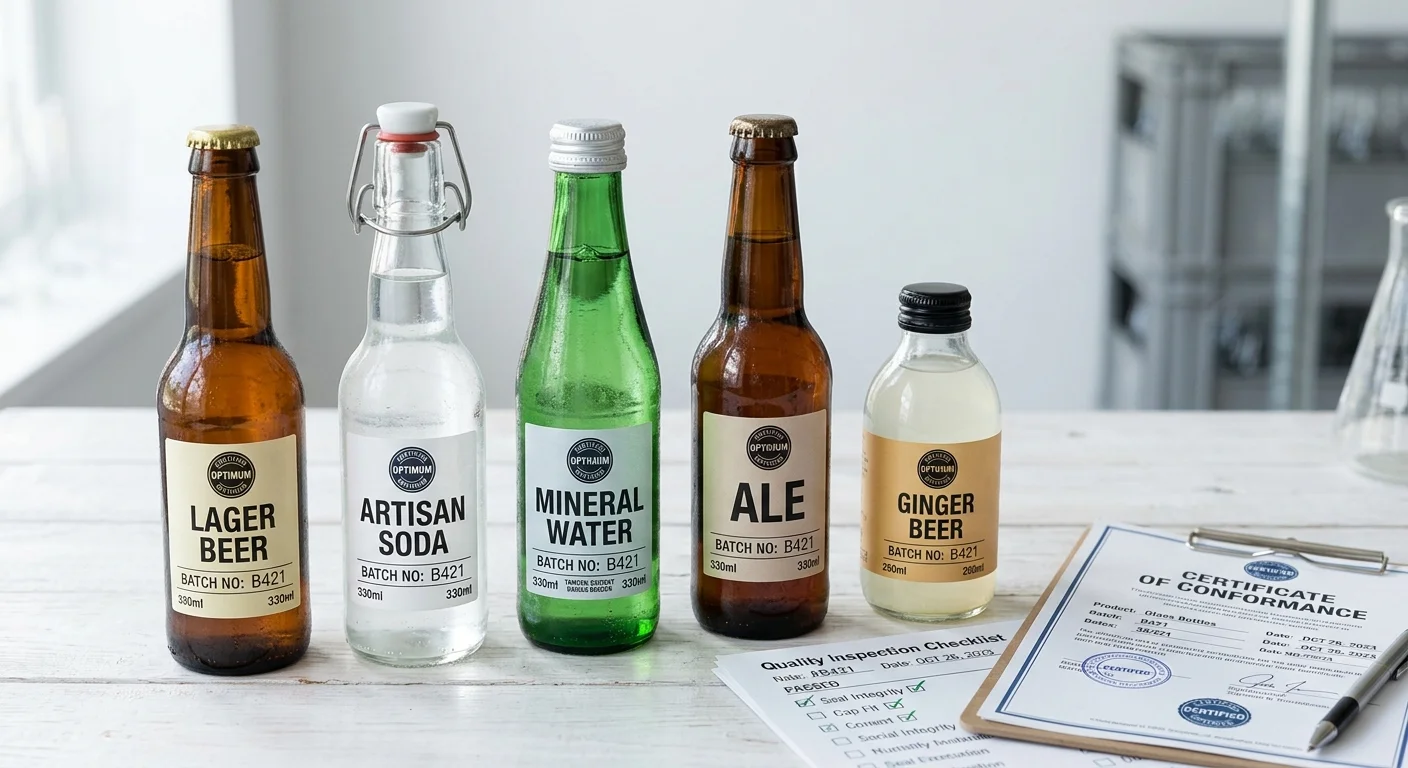
Certifications aren’t paperwork. They’re proof that your supplier can back up every claim they make about their product.
Sourcing wholesale glass beverage bottles for commercial distribution? Missing the right documentation doesn’t just create compliance headaches — it can block your product from entering its target market. Here’s what to demand before you sign anything.
The Four Documents That Matter
FDA Compliance (USA)
Selling into the U.S. market means your glass must meet FDA food-contact material standards. Ask your glass soda bottles supplier or glass juice bottles wholesale vendor for written confirmation that their glass formulation complies with 21 CFR (Code of Federal Regulations). No documentation? Walk away.
ISO 9001 Certification
This one tells you how a factory operates — not just what it produces. ISO 9001 means the manufacturer runs a documented quality management system with traceable processes. For glass water bottles bulk orders, this is your baseline protection against inconsistent production batches.
LFGB (European Market)
Selling into Germany, France, or anywhere in the EU? LFGB sets the standard for food-contact materials under German law. It’s stricter than most buyers expect. Your beverage packaging glass supplier must provide current LFGB test reports — not outdated ones.
SGS or Third-Party Lab Reports
ISO and LFGB certificates confirm a factory passed at some point. SGS reports — or equivalent third-party testing — confirm their current production still holds up. Request recent batch test results. A certificate issued three years ago isn’t enough.
Match Your Certifications to Your Target Market
| Market | Key Certification |
|---|---|
| USA | FDA 21 CFR compliance |
| European Union | LFGB, REACH |
| Global / Multi-market | ISO 9001 + SGS reports |
A solid supplier of amber glass beverage bottles or glass kombucha bottles bulk keeps these documents ready to share. Can’t get them fast? That tells you a lot about how that supplier runs their operation.
Custom Glass Beverage Bottle Options: OEM Logos, Shapes, Colors & What Each Costs
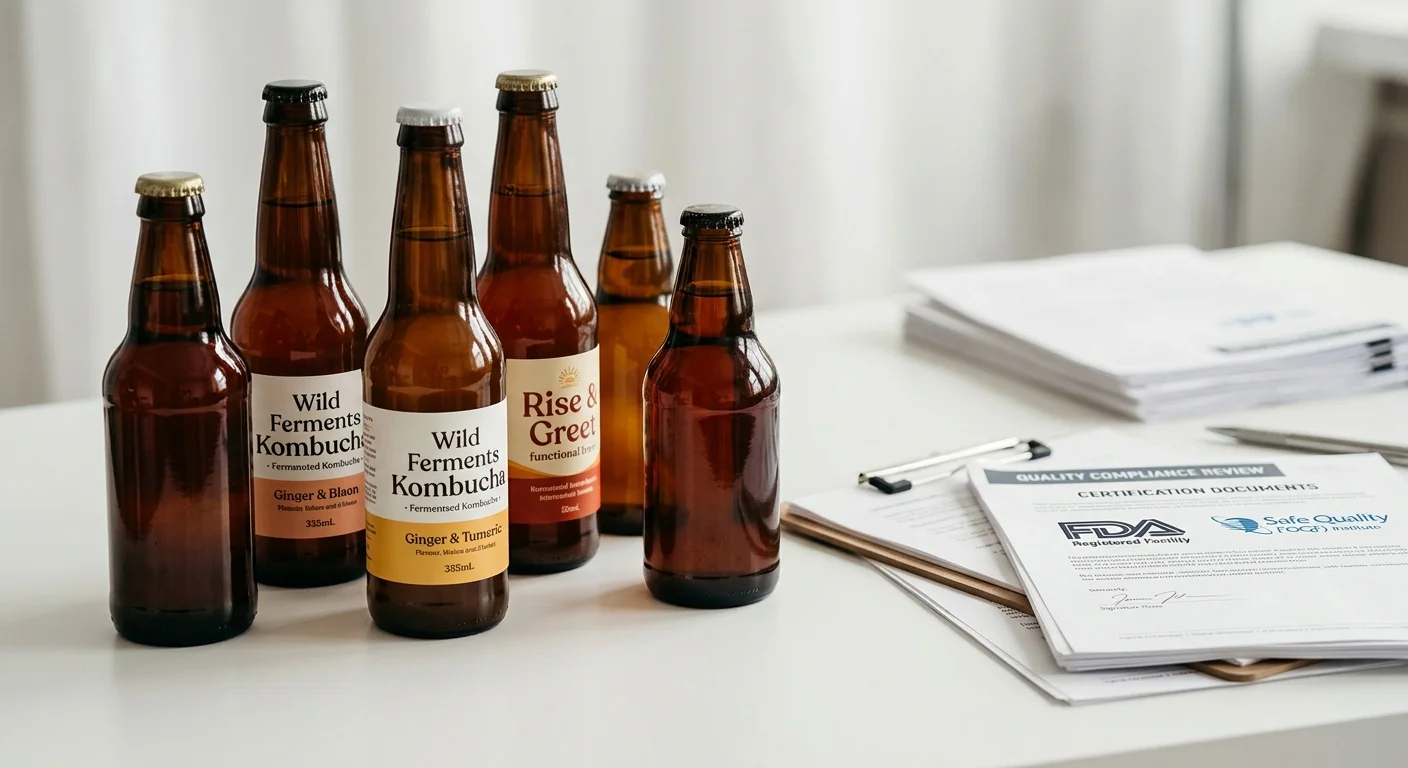
Customization is where your brand either stands out on the shelf — or disappears into a sea of generic bottles. The good news: there are options across different budgets and order sizes. The bad news: most buyers don’t know the difference until they’ve already overpaid.
Here’s how the customization tiers break down.
Tier 1: Surface Customization (Low Barrier to Entry)
Most brands start here — and for good reason. Surface customization covers screen printing, acid etching, and sleeve labeling applied to a standard bottle mold.
What you get:
– Your logo, brand colors, and product info on an existing bottle shape
– No tooling fees or mold costs
– Lower MOQ — starting from 1,000–3,000 units depending on the supplier
What it costs: Screen printing adds $0.10–$0.30 per bottle at volume. Acid etching costs a bit more, but it gives you a premium frosted look with stronger shelf presence.
This route works well for startups testing a new SKU or brands that need to move fast. You don’t get a unique bottle shape — but your branding stays visible and distinctive.
Tier 2: Custom Mold & Proprietary Bottle Shape (Full OEM)
Some brands need a bottle shape no one else can copy — a signature tapered waist, an embossed panel, a silhouette that’s 100% yours. That means proprietary mold development.
What this involves:
– One-time mold tooling fee: $2,000–$8,000+ depending on complexity
– Longer lead times: add 60–90 days for mold production and sample approval
– Higher MOQs: most factories require 5,000–10,000 units minimum per run to cover tooling costs
Established beverage packaging glass brands take this route after they’ve validated their product and want a bottle no competitor can duplicate. For early-stage brands, the upfront cost is hard to justify.
Factory Direct vs. Wholesaler: MOQ Reality Check
Your source changes your minimum order requirements — by a wide margin.
| Source | Typical MOQ | Customization Access |
|---|---|---|
| Factory Direct | 3,000–10,000 units | Full OEM, mold development available |
| Wholesaler / Distributor | 500–2,000 units | Surface printing only, standard shapes |
Going factory-direct through a glass bottle with lid wholesale manufacturer gives you more control — over specs, pricing, and customization depth. The trade-off is higher volume commitments and longer lead times.
Wholesalers fit better for smaller order volumes or tight timelines. You give up some customization options, but you get faster turnaround and a lower entry point.
Color Customization: What’s Standard and What Costs Extra
Most suppliers carry clear glass drink bottles and amber glass beverage bottles as standard stock. Green glass is also easy to find.
Custom colors — deep cobalt blue, black glass, specialty tints — need a dedicated production run. That means a higher MOQ and extra cost per unit. Build custom color into your sourcing timeline from the start. It’s not something a supplier can add at the last minute on a large order.
The right customization level depends on where your brand stands right now. Surface printing gets you to market fast. Proprietary molds build long-term brand equity. Know which stage you’re in — and source to match it.
Where to Source Wholesale Glass Beverage Bottles: Manufacturers, Distributors & Platform Comparison
Three sourcing channels dominate the wholesale glass bottle market. Each serves a different buyer profile. Pick the wrong one and you lose money, time, or both.
Chinese Manufacturers: Lowest Cost, Highest Customization
Direct factory sourcing from China gives you the best unit economics. Full OEM capability, custom molds, color options, surface printing — it’s all available. The trade-off is volume. Factories require 3,000–10,000 units minimum. Lead times run 30–60 days before ocean freight.
For brands ready to scale, this is where the real margin lives.
TP Glass Bottle is a China-based manufacturer focused on custom glass beverage bottles for B2B buyers. They cover amber glass beverage bottles, glass kombucha bottles bulk, and proprietary mold development. Sourcing at volume with customization needs? Send them a direct inquiry.
Local Distributors (US/EU): Speed Over Savings
North American and European distributors hold stock and ship fast — often within 5–10 business days. MOQs drop to as low as 500 units.
The catch: prices run 20–40% higher than factory-direct. Customization is limited to standard bottle shapes with surface printing. Good for urgent restocks or market testing. Not the right fit for long-term cost efficiency.
B2B Platforms: Alibaba & Global Sources
Platforms like Alibaba and Global Sources put dozens of verified glass soda bottles suppliers and glass water bottles bulk vendors in one place. You can compare specs, certifications, and MOQs side by side — no blind RFQs needed.
The downside? Vetting still falls on you. Check factory audit reports. Request SGS documentation. Order samples before committing to volume.
| Channel | MOQ | Lead Time | Best For |
|---|---|---|---|
| Chinese Manufacturer | 3,000–10,000 units | 30–60 days | Scale + customization |
| Local Distributor | 500–2,000 units | 5–10 days | Speed + flexibility |
| B2B Platform | Varies | Varies | Comparison + discovery |
Match your channel to your stage. Scaling brands go factory-direct. Early-stage or time-sensitive buyers go local or platform-sourced.
Conclusion
Choosing the right food-grade glass materials, functional caps, and essential certifications (SGS, ISO, FDA) are key to successful wholesale custom glass beverage bottle purchases, ensuring safety, quality and brand credibility. At TP Glass Bottle Manufacturer, we integrate these elements into our production. As your trusted partner, we turn your vision into quality packaging with cost-effective pricing and on-time delivery. Contact us to discuss your custom needs and start your seamless purchasing journey.