
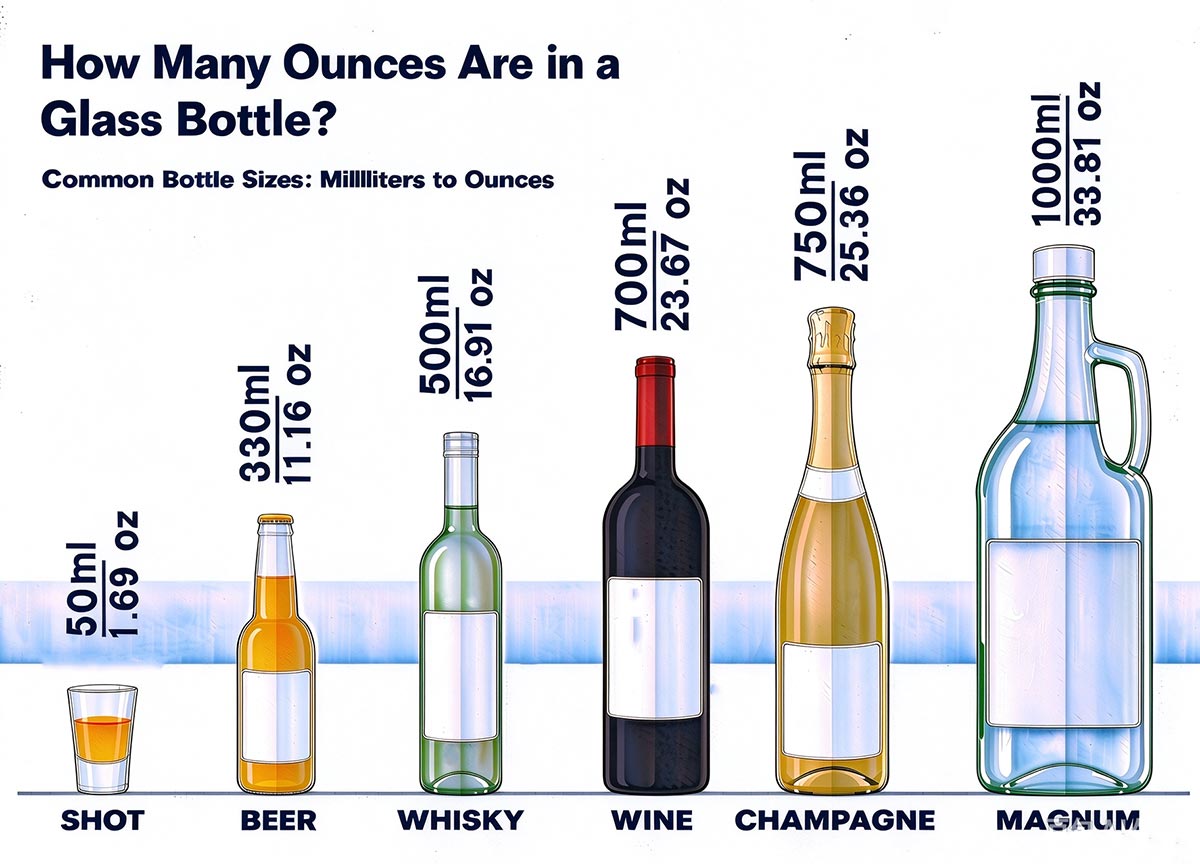
Introduction
How many ounces are in a bottle? The answer depends on the size of the bottle. There is no single standard bottle capacity, so the number of ounces can vary widely between small bottles, liquor bottles, wine bottles, and other beverage containers.
For example, a 750ml bottle contains about 25.4 US fluid ounces, while a 1-liter bottle contains about 33.8 US fluid ounces. Smaller 50ml bottles contain only about 1.7 fluid ounces.
Understanding common bottle sizes can make it easier to compare products, calculate servings, and convert between milliliters and ounces. In this guide, we explain how many ounces are in common bottle sizes and show a simple bottle size conversion chart.
Note: This article uses US fluid ounces (fl oz) for liquid volume. One US fluid ounce is approximately 29.57 milliliters.
Table of Contents
How Many Ounces Are in a Bottle?
A bottle can contain different amounts depending on its nominal capacity. Some common bottle sizes range from small 50ml bottles to 1.5-liter bottles and larger containers.
Here is a quick comparison of common bottle sizes in ounces:
| Bottle Size | Approx. US Fluid Ounces |
|---|---|
| 50ml | 1.69 oz |
| 100ml | 3.38 oz |
| 200ml | 6.76 oz |
| 250ml | 8.45 oz |
| 330ml | 11.16 oz |
| 355ml | 12.00 oz |
| 375ml | 12.68 oz |
| 500ml | 16.91 oz |
| 700ml | 23.67 oz |
| 750ml | 25.36 oz |
| 1 liter | 33.81 oz |
| 1.5 liters | 50.72 oz |
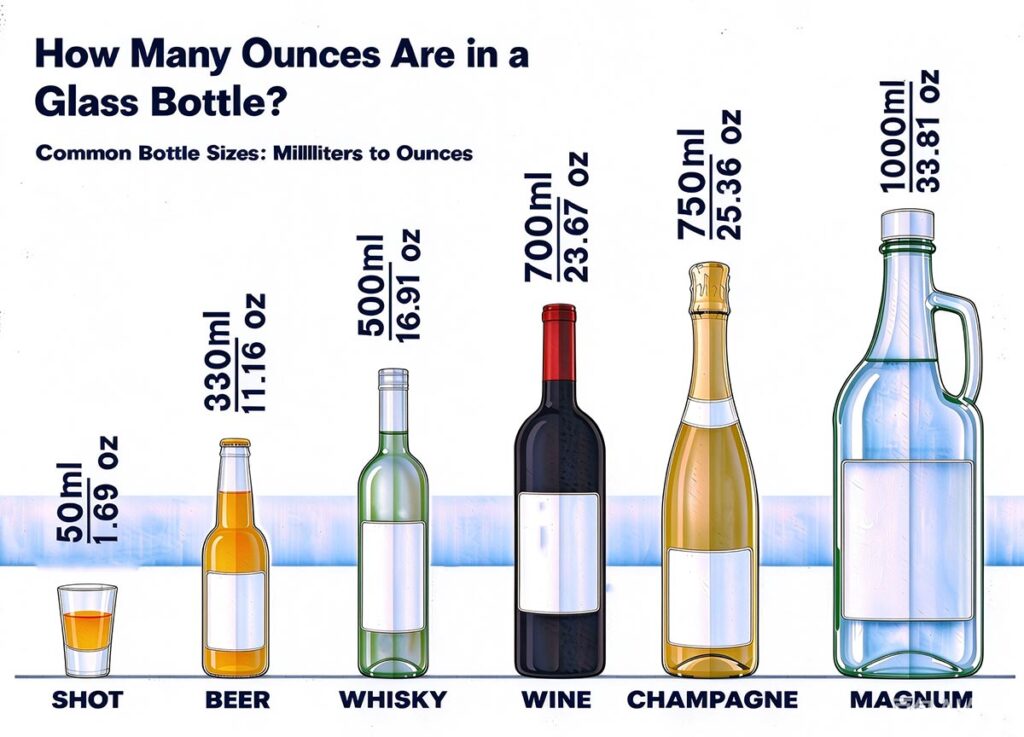
Common Bottle Sizes in Ounces
Different industries use different bottle capacities. Some sizes are especially common for spirits, wine, beer, food, and other beverages.
50ml and 100ml Bottles
Small bottles are often used for samples, mini liquor bottles, travel-size products, and single-use packaging. A 50ml bottle holds about 1.69 US fluid ounces, while a 100ml bottle holds about 3.38 ounces. These sizes are useful when a product needs to be compact or when a smaller serving size is preferred.
200ml to 500ml Bottles
Bottle sizes between 200ml and 500ml are common for a variety of beverages and packaged products.
A few useful conversions include:
- 200ml = about 6.76 oz
- 250ml = about 8.45 oz
- 330ml = about 11.16 oz
- 375ml = about 12.68 oz
- 500ml = about 16.91 oz
These capacities are often used for individual or smaller-format beverage packaging.
750ml Bottles
750ml is one of the most familiar bottle sizes for wine and spirits. So, how many ounces are in a 750ml bottle?
A 750ml bottle contains approximately 25.4 US fluid ounces.
You may also see this written as 25.36 fl oz when using a more precise conversion. Because 750ml is widely used for alcoholic beverages, the size is often treated as a standard reference when comparing liquor bottle sizes or wine bottle sizes. For glass packaging, a 750ml bottle can be produced in many different shapes, including round, square, rectangular, and custom designs. The bottle’s appearance can change while the nominal capacity remains 750ml.
1-Liter Bottles
A 1-liter bottle is larger than a standard 750ml bottle. 1 liter equals 1,000ml, which is approximately 33.8 US fluid ounces. This size is common for spirits, beverages, water, and other liquid products. Compared with a 750ml bottle, a 1-liter bottle holds about 8.45 more US fluid ounces.
How to Convert Milliliters to Ounces
Converting bottle sizes from milliliters to ounces is simple once you know the basic formula.
The Conversion Formula
To convert milliliters to US fluid ounces:
US fluid ounces = milliliters ÷ 29.5735
For example:
750ml ÷ 29.5735 = 25.36 US fl oz
So a 750ml bottle contains approximately 25.4 ounces.
Here are a few more examples:
- 250ml ÷ 29.5735 = 8.45 oz
- 375ml ÷ 29.5735 = 12.68 oz
- 500ml ÷ 29.5735 = 16.91 oz
- 1,000ml ÷ 29.5735 = 33.81 oz
When converting bottle capacities for everyday use, rounding to one decimal place is usually enough. For product specifications, packaging documents, or labeling, use the required level of precision for your market.
Bottle Sizes by Product Type
Bottle capacities vary by product category. Some sizes are especially common in liquor, wine, and beer packaging.
Liquor Bottle Sizes
Liquor bottles are available in many capacities, from small miniatures to larger bottles. Common liquor bottle sizes include:
- 50ml
- 200ml
- 375ml
- 500ml
- 700ml
- 750ml
- 1 liter
Among these, 750ml and 1-liter bottles are particularly common reference sizes for spirits. The actual bottle design can vary significantly. A premium whiskey bottle, for example, may be shorter and wider than a traditional round spirit bottle even when both have the same nominal capacity.
Wine Bottle Sizes
A standard wine bottle is commonly 750ml, which is approximately 25.4 US fluid ounces. Other wine bottle sizes include:
- 375ml = about 12.7 oz
- 750ml = about 25.4 oz
- 1.5L = about 50.7 oz
Larger wine bottles are also available for certain products and markets.
Beer Bottle Sizes
Beer bottles come in a wide range of capacities depending on the country, market, and product. Common examples include:
- 330ml = about 11.2 oz
- 355ml = about 12.0 oz
- 500ml = about 16.9 oz
A 355ml bottle is especially familiar in the United States because it is very close to 12 US fluid ounces. When comparing beer bottle sizes, it is important to check the actual nominal volume rather than assuming every bottle has the same capacity.
Why Bottle Size Matters
Bottle capacity is more than just a number on a product label. It can affect how a product is packaged, sold, stored, and transported. For consumers, bottle size helps determine how much liquid a container holds and how it compares with other products. For product packaging, capacity is also closely related to the bottle’s dimensions. A 750ml bottle may have different height, diameter, shoulder shape, and base dimensions depending on the design.
For example, two 750ml glass bottles may have the same nominal volume but look very different because of their shape and proportions. The weight of the glass can also vary between designs. When specifying a bottle, it is therefore useful to consider not only capacity, but also dimensions, weight, neck finish, closure compatibility, and overall bottle shape. For more information, see our guide to glass bottle specifications, which covers dimensions, weight, capacity, and neck finishes in greater detail.
FAQs
How many ounces are in a 750ml bottle?
A 750ml bottle contains approximately 25.4 US fluid ounces. More precisely, 750ml equals about 25.36 US fl oz.
How many ounces are in a 1-liter bottle?
A 1-liter bottle contains approximately 33.8 US fluid ounces. Since 1 liter equals 1,000ml, the conversion is 1,000 ÷ 29.5735.
How many ounces are in a standard wine bottle?
A commonly used standard wine bottle has a capacity of 750ml, which is approximately 25.4 US fluid ounces.
How many ounces are in a standard beer bottle?
Beer bottle sizes vary by market. A 330ml bottle contains about 11.2 US fluid ounces, while a 355ml bottle contains about 12 US fluid ounces.
Is 750ml the same as 25 ounces?
Not exactly. 750ml is approximately 25.36 US fluid ounces, so it is slightly larger than 25 ounces.
How many ounces are in a small liquor bottle?
A common miniature liquor bottle has a capacity of 50ml, which equals approximately 1.69 US fluid ounces. Other small liquor bottles may have capacities such as 100ml or 200ml.
Final Takeaway
There is no single answer to how many ounces are in a bottle because bottle sizes vary. The most useful approach is to look at the bottle’s capacity in milliliters and convert it to US fluid ounces. Some common reference points are:
- 50ml = 1.7 oz
- 375ml = 12.7 oz
- 500ml = 16.9 oz
- 750ml = 25.4 oz
- 1L = 33.8 oz
- 1.5L = 50.7 oz
For wine and spirits, 750ml is an especially familiar bottle size, while beer bottles are commonly found in smaller capacities such as 330ml, 355ml, and 500ml. Knowing these common bottle sizes makes it easier to compare products, understand packaging specifications, and choose the right bottle capacity for a particular application.