
Introduction
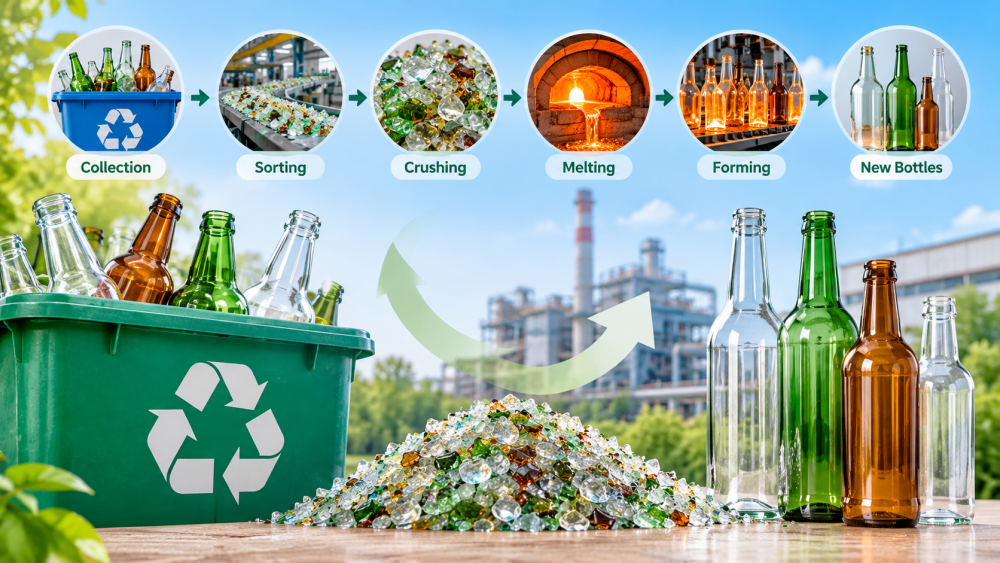
Have you ever wondered what happens after an empty glass bottle goes into a recycling bin? Suitable bottles and jars can be processed and used to make new glass packaging. The journey typically involves collection, sorting, cleaning, crushing, melting, and forming.
Understanding how glass bottles are recycled shows why proper sorting matters and how recycled glass supports bottle manufacturing. Although collection systems vary between regions, the main stages of the glass bottle recycling process are broadly similar.
Table of Contents
1. Why Are Glass Bottles Recyclable?
Most food and beverage bottles are made from soda-lime glass, which is produced mainly from silica sand, soda ash, and limestone. Unlike some materials that can lose important properties during repeated processing, container glass can be melted and formed again without a significant loss of its basic material properties.
Recycled glass, known in the industry as cullet, can replace part of the virgin raw materials used in glass manufacturing. This helps reduce the demand for newly extracted materials and can lower the energy required for melting.
However, the quality of recovered glass matters. Mixed colors and contaminants can limit whether collected glass is suitable for making new bottles and jars.
2. How Are Glass Bottles Recycled? The Step-by-Step Process
The equipment and exact order of operations can vary between facilities, but a typical glass bottle recycling process includes the following stages.
Step 1 – Collection and Transportation
Used glass bottles and jars are collected through household recycling bins, commercial collection programs, bottle-return schemes, or designated drop-off points. They are then transported to a recycling or glass-processing facility.
Some regions collect glass separately, while others collect it with mixed recyclables and separate it during processing.
Step 2 – Sorting by Glass Type and Color
At the recycling facility, glass packaging is separated from other materials and sorted by color. The main container-glass colors are clear, green, and amber.
Color sorting helps manufacturers control the appearance and consistency of new containers. Clear glass, for example, needs to meet specific color requirements. Optical sorting equipment can identify and separate glass by color, while other systems remove unsuitable materials.
Step 3 – Removing Contaminants and Cleaning
Collected glass may contain metal caps, plastic components, paper labels, ceramics, stones, or leftover product. Processing equipment such as screens, magnets, air separators, and optical sensors helps remove these contaminants.
This stage is particularly important because ceramic and stone fragments can cause defects in new glass containers. Food residue and other unwanted materials are also managed during processing.
Step 4 – Crushing Glass into Cullet
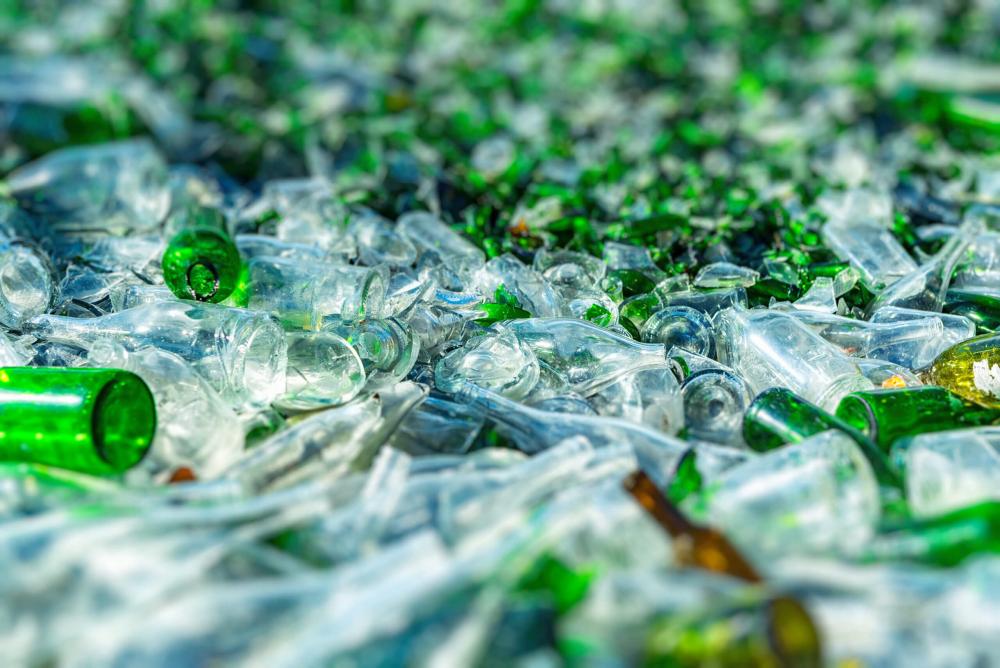
Once the glass has been sorted and prepared, it is crushed into small pieces called cullet. The pieces are screened to achieve suitable sizes, and additional sorting may remove remaining impurities.
Cullet is a valuable secondary raw material for glass manufacturers. Clean, well-sorted cullet is easier to reuse in container-glass production and helps maintain the consistency required for new bottles and jars.
Step 5 – Melting Recycled Glass
Processed cullet is transported to a glass manufacturing plant, where it is combined with other raw materials as required by the production formula. Common ingredients include silica sand, soda ash, and limestone.
The mixture is heated in a glass furnace until it becomes molten glass. The proportion of cullet used depends on factors such as its color, purity, availability, and the specifications of the finished product.
Using recycled glass can reduce the demand for virgin raw materials and lower melting energy requirements. The actual savings depend on the composition of the batch and the operation of the furnace.
Step 6 – Forming New Glass Bottles and Jars
Once the molten glass reaches the required condition, it is divided into measured portions called gobs. Each gob is delivered to a moulding machine, where it is shaped into a bottle or jar through processes such as blow-and-blow or press-and-blow forming.
The mould determines the container’s shape, dimensions, and design details. At this stage, recycled glass re-enters the glass bottle manufacturing process and becomes new packaging for food, beverages, cosmetics, and other products.
Step 7 – Annealing, Inspection, and Distribution
Newly formed glass containers are still hot and need controlled cooling. They pass through an annealing lehr, where the temperature is gradually reduced to relieve internal stress and improve durability.
After annealing, bottles and jars undergo quality checks. Depending on the product, inspections may cover dimensions, weight, appearance, and defects such as cracks. Containers that meet the required specifications are packed and shipped to filling and packaging companies.
3. What Types of Glass Can Be Recycled?
Not every glass item belongs in the same recycling stream. Standard food and beverage bottles and jars are commonly accepted in container-glass recycling programs. Other glass products may have different compositions or be designed to withstand different temperatures, making them unsuitable for the same process.
| Glass Item | Usually Accepted with Bottle and Jar Recycling? |
|---|---|
| Beverage bottles | Yes |
| Food and sauce jars | Yes |
| Drinking glasses | No |
| Window glass and mirrors | No |
| Heat-resistant cookware, such as Pyrex | No |
| Ceramics and porcelain | No |
These are general guidelines. Local recycling programs may have additional restrictions, so consumers should check the rules in their area. Keeping unsuitable glass and ceramics out of container-glass collections helps protect the quality of recovered material.
4. Can Glass Bottles Be Recycled Indefinitely?
Glass is often described as infinitely recyclable because it can be melted and remade repeatedly without losing its basic material properties. In principle, suitable container glass can re-enter the recycling process many times.
In practice, not all collected glass returns to bottle and jar production. Some material is lost during collection and processing, while contamination or mixed colors can make certain batches unsuitable for new containers. Glass that does not meet container-manufacturing requirements may be used in other applications, depending on its quality and local recycling markets.
Therefore, glass has strong potential for repeated recycling, but the effectiveness of the system depends on proper collection, sorting, and processing.
5. Environmental Benefits of Glass Bottle Recycling
Recycling glass supports more efficient use of materials throughout the packaging supply chain.
- Reduced use of virgin materials: Cullet can replace part of the silica sand, soda ash, and limestone needed to produce new glass.
- Lower melting energy requirements: Recycled glass generally requires less energy to melt than an equivalent batch made entirely from virgin raw materials. Actual savings vary with production conditions.
- Less waste sent to landfill: Recovering bottles and jars keeps suitable glass in productive use rather than disposing of it as general waste.
- Support for a circular packaging system: Recycled glass can become new bottles and jars, allowing packaging materials to circulate between consumers, recyclers, and manufacturers.
The environmental benefits depend on collection quality, transport distances, processing efficiency, and the proportion of recycled glass used in manufacturing.
6. How to Prepare Glass Bottles for Recycling
A few simple steps can help improve the quality of collected glass:
- Empty bottles and jars before placing them in a recycling container.
- Scrape out leftover food and rinse containers if needed.
- Follow local instructions for removing or keeping caps, lids, and closures.
- Keep drinking glasses, mirrors, window glass, cookware, and ceramics out of ordinary bottle and jar recycling unless a separate program accepts them.
Containers do not usually need to be spotless, but excessive food or liquid residue can cause problems during collection and processing.
FAQ
What Happens to Glass Bottles After They Are Recycled?
Suitable bottles are sorted, cleaned, crushed into cullet, and sent to a glass manufacturing plant. The cullet is melted and formed into new bottles, jars, or other glass products.
What Is Cullet in Glass Recycling?
Cullet is the industry term for crushed recycled glass. It is used as a secondary raw material in glass manufacturing and can replace part of the virgin materials in a new glass batch.
Can Glass Bottles Be Recycled More Than Once?
Yes. Container glass can be melted and remade repeatedly without losing its basic material properties. Actual recycling cycles depend on collection quality, contamination, and processing conditions.
Do Glass Bottles Need to Be Washed Before Recycling?
Usually, bottles should be emptied and lightly rinsed if they contain food or liquid residue. They do not generally need a thorough wash. Always follow local recycling instructions.
Why Can’t Drinking Glasses and Pyrex Be Recycled with Glass Bottles?
They may have different compositions and melting characteristics from standard container glass. If mixed into bottle-glass production, they can cause defects in new containers.
Conclusion
Glass bottle recycling turns used packaging into a valuable manufacturing resource. From collection and color sorting to cullet preparation, melting, and bottle forming, each stage helps prepare glass for another use.
For glass packaging manufacturers, recycled glass is an important part of material efficiency and more circular production. At TP Glass Bottle, we recognize the role that responsible material use and effective manufacturing practices play in the future of glass packaging.