
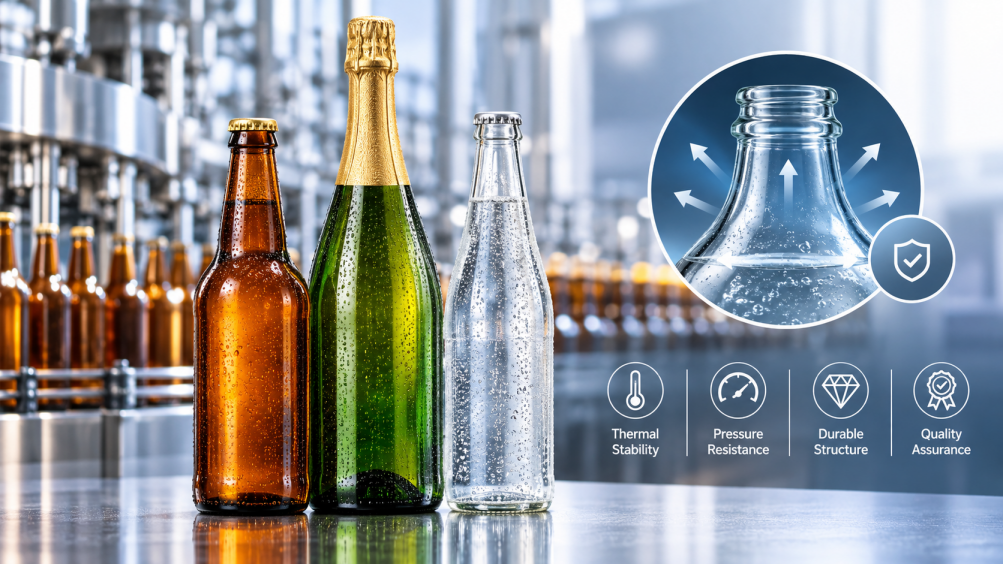
Carbonated drinks such as beer, sparkling water, soda, and champagne contain dissolved carbon dioxide (CO₂), which creates internal pressure inside the bottle. Unlike bottles used for still beverages, glass bottles for carbonated drinks must be designed to withstand this pressure during filling, storage, transportation, and handling.
So, how are glass bottles made strong enough to hold carbonated beverages? The answer involves more than simply using thicker glass. Bottle shape, glass distribution, forming conditions, annealing, and quality testing all contribute to the final performance.
In this article, we will explore how pressure-resistant glass bottles are designed and manufactured, how their strength is tested, and what beverage brands should consider when selecting bottles for carbonated products.
Table of Contents
Why Do Carbonated Drinks Need Pressure-Resistant Glass Bottles?
Carbonated beverages contain dissolved CO₂. When a bottle is filled and sealed, the carbon dioxide creates pressure inside the container. The pressure can change depending on several factors, including carbonation level, storage temperature, and the characteristics of the beverage.
For example, beer, sparkling wine, and carbonated soft drinks do not necessarily have the same pressure requirements. Some beverages also undergo additional processing, such as pasteurization, which can affect the conditions that the bottle must withstand.
When internal pressure increases, it places stress on the glass walls. If the bottle has weak areas, manufacturing defects, or an unsuitable structure, it may crack or break.
This is why glass bottles for carbonated drinks require careful design and production control. Their performance must match the intended beverage, filling process, and storage conditions.
A suitable bottle should provide:
- Sufficient resistance to internal pressure.
- Consistent glass distribution throughout the bottle.
- Reliable sealing with the selected closure.
- Adequate resistance to temperature changes and handling.
- Consistent performance during large-scale production and distribution.
What Makes a Glass Bottle Strong Enough for Carbonated Drinks?
The pressure resistance of a glass bottle depends on several interconnected factors. A well-designed bottle needs to distribute stress effectively and avoid weak points that could cause failure.
Bottle Shape and Structural Design
Bottle geometry plays an important role in pressure resistance. The body, shoulder, neck, and base all contribute to how internal pressure is handled.
A well-designed shape helps avoid sharp transitions and unnecessary stress concentrations. Smooth curves and properly designed structural transitions can help distribute stress more evenly throughout the bottle.
For example, champagne bottles commonly feature a deep indentation at the base, known as a punt. This traditional design is associated with sparkling wine bottles and forms part of their overall structural geometry. However, the punt alone does not determine pressure resistance. The entire bottle structure, glass distribution, and manufacturing quality must work together.
Glass Thickness and Distribution
Glass thickness is another important consideration when manufacturing pressure-resistant glass bottles.
The glass needs to be distributed appropriately across the bottle body, shoulder, and base. Areas with insufficient glass or inconsistent thickness may become potential weak points under internal pressure.
However, thicker glass does not automatically mean a stronger bottle. Excessive weight can increase material consumption without necessarily improving overall performance.
Manufacturers must consider the relationship between bottle weight, wall thickness, shape, and production consistency. A suitable design provides the required strength while maintaining practical weight and material efficiency.
Neck Finish and Closure Compatibility
The bottle opening is also important because carbonated beverages need a reliable seal to retain CO₂.
Different beverage bottles use different closure systems:
- Beer bottles commonly use crown caps.
- Champagne and sparkling wine bottles typically use corks secured with wire cages.
- Some carbonated beverage bottles use screw caps or other compatible sealing systems.
The neck finish must match the selected closure in dimensions and design. Even when the bottle body has sufficient pressure resistance, an unsuitable closure or poor sealing performance can lead to leakage or loss of carbonation.
For this reason, bottle design should consider the bottle body, neck finish, and closure as one packaging system.
How Are Carbonated Beverage Glass Bottles Manufactured?
The manufacturing process for carbonated beverage glass bottles follows the main steps used in regular glass bottle production. However, additional attention is given to structural consistency, residual stress, and pressure-related quality requirements.
Bottle Design and Mold Development
The process begins with bottle specifications and design requirements. Manufacturers need to understand the intended beverage, carbonation level, filling conditions, capacity, and closure type before developing the bottle design.
Based on these requirements, engineers determine the bottle dimensions, body shape, weight, and glass distribution.
For custom glass bottles, mold development is an important stage. The mold must support the intended shape while allowing the glass to form consistently during production.
Glass Forming and Thickness Control
After raw materials are melted at high temperatures, molten glass is cut into measured portions called gobs. These glass portions are transferred into forming machines, where they pass through blank molds and final molds to create the bottle shape.
During this process, the amount and distribution of glass need to be controlled carefully.
Uneven glass distribution can create thin areas or variations between bottles. For carbonated beverage bottles, maintaining consistent wall thickness and structural dimensions helps reduce the risk of weak points.
Modern glass forming equipment and properly designed molds play an important role in maintaining production consistency.
Annealing and Surface Treatment
Once formed, glass bottles are still under thermal stress because different areas cool at different rates.
The bottles pass through an annealing lehr, where temperature is carefully controlled to allow the glass to cool gradually. This process helps reduce residual stress inside the glass.
Proper annealing is particularly important for bottles designed to withstand internal pressure. Excessive residual stress can affect their mechanical performance.
Surface treatments may also be applied to improve resistance to scuffing and abrasion during handling, filling, and transportation. Although these treatments do not replace proper structural design, they help protect the bottle surface and maintain quality during use.
How Are Pressure-Resistant Glass Bottles Tested?
Manufacturing controls help create consistent bottles, but testing is necessary to verify whether they meet the required performance specifications.
Several inspection methods can be used to evaluate glass bottles for carbonated drinks.
Internal Pressure Resistance Testing
Internal pressure testing is one of the most important methods for evaluating carbonated beverage glass bottles.
In a typical hydraulic test, a bottle is filled with water and connected to a pressure testing system. The pressure inside the bottle is gradually increased while the equipment records the results.
Depending on the testing procedure, the bottle may be tested at a specified pressure for a set period or subjected to gradually increasing pressure until failure.
The results help manufacturers evaluate the bottle’s resistance to internal pressure and identify potential weak areas.
ISO 7458 specifies two methods for determining the internal pressure resistance of glass containers:
- Method A applies a uniform internal pressure for a predetermined period.
- Method B increases internal pressure at a predetermined rate.
These methods provide a basis for evaluating bottle performance under controlled testing conditions.
Thermal Shock and Annealing Stress Testing
Temperature changes can affect carbonated beverage packaging, particularly when bottles are exposed to heating or cooling during filling, processing, and storage.
Thermal shock testing evaluates how well a glass bottle withstands rapid temperature changes.
Annealing quality can also be checked using polarized light inspection. This method helps identify residual stress patterns that may indicate issues with the cooling process.
These inspections are useful for checking manufacturing consistency and identifying potential quality problems.
Impact, Dimensions, and Visual Inspection
In addition to pressure resistance, manufacturers need to inspect other aspects of bottle quality.
Common checks include:
- Wall thickness and weight: Checking whether the bottle meets its design specifications.
- Neck finish dimensions: Ensuring compatibility with the intended closure.
- Impact resistance: Evaluating the bottle’s ability to withstand handling and contact during production and transportation.
- Visual inspection: Checking for cracks, bubbles, stones, and other visible defects.
Together, these checks help manufacturers maintain consistent quality and ensure that bottles are suitable for their intended application.
Beer Bottles vs. Champagne Bottles vs. Soda Bottles
Although all these containers are used for carbonated beverages, their design requirements can differ considerably.
| Bottle Type | Main Design Considerations |
|---|---|
| Beer Bottles | Carbonation level, filling conditions, possible pasteurization, and crown cap compatibility |
| Champagne Bottles | Higher pressure requirements, reinforced structural design, and cork and wire cage compatibility |
| Soda Bottles | Carbonation level, storage temperature, filling conditions, and reliable cap sealing |
Beer Bottles
Beer bottles are designed to retain carbonation and withstand the pressure generated by the beverage. Their specifications need to account for carbonation levels, filling conditions, and whether the beer undergoes pasteurization.
Crown cap compatibility is also important for maintaining a reliable seal.
Champagne Bottles
Champagne and other sparkling wine bottles generally need to withstand higher internal pressures than many standard beer and soft drink bottles.
They typically feature a heavier glass structure, a reinforced base design, and a neck finish suitable for cork and wire cage closures.
Soda Bottles
Glass soda bottles are used for carbonated soft drinks and sparkling water. Their design needs to match the beverage’s carbonation level, storage temperature, and filling process.
Depending on the product, manufacturers may use different bottle capacities, body shapes, and closure systems.
The key point is that there is no single bottle design suitable for every carbonated beverage. Each application requires specifications based on its actual operating conditions.
What Should Buyers Consider When Choosing Glass Bottles for Carbonated Drinks?
For beverage brands and packaging buyers, selecting suitable glass bottles involves more than comparing bottle shapes and prices.
The following factors should be considered before placing a bulk order.
1. Carbonation Level and Expected Pressure
Start by identifying the beverage’s carbonation level and expected internal pressure. Share this information with your bottle manufacturer so that the bottle design and testing requirements can be evaluated appropriately.
2. Bottle Design and Glass Distribution
Consider the bottle’s body shape, weight, wall thickness, and base structure. These factors influence both pressure resistance and production consistency.
3. Filling and Processing Conditions
Provide details about filling temperature, pasteurization, and other production conditions. A bottle designed for one filling process may not be suitable for another without further evaluation.
4. Neck Finish and Closure Compatibility
Confirm that the bottle opening matches your chosen crown cap, cork, screw cap, or other closure system.
5. Pressure Testing and Quality Control
Ask your supplier about internal pressure testing methods, inspection procedures, and product specifications. Testing requirements should be established based on the beverage and its intended use rather than relying on general pressure values.
6. Customization and Production Consistency
For brands developing their own packaging, custom bottle shapes, capacities, colors, and surface finishes can help create a distinctive product. However, customization should always maintain the structural requirements of carbonated beverage packaging.
Working with an experienced glass bottle manufacturer can help buyers coordinate bottle design, mold development, production specifications, and quality requirements from the beginning.
Frequently Asked Questions
1. Can Regular Glass Bottles Be Used for Carbonated Drinks?
Not all regular glass bottles are suitable for carbonated beverages. Bottles must be designed and tested to withstand the expected internal pressure. Their shape, glass distribution, and closure system all need to meet the requirements of the intended beverage.
2. Are Thicker Glass Bottles Always More Pressure-Resistant?
No. Glass thickness is only one factor affecting pressure resistance. Bottle shape, glass distribution, manufacturing consistency, and residual stress also influence performance. A properly designed bottle can achieve the required strength without simply increasing its weight.
3. How Is the Internal Pressure Resistance of Glass Bottles Tested?
A common method involves filling the bottle with water and gradually increasing the internal hydraulic pressure. The equipment records the pressure the bottle can withstand or the pressure at which it breaks. ISO 7458 provides standardized test methods for glass container pressure resistance.
4. Are Champagne Bottles Stronger Than Beer Bottles?
Champagne bottles are generally designed for higher internal pressure than many standard beer bottles. However, the actual performance depends on the specific bottle design, production quality, and testing requirements. Bottle weight alone is not enough to determine its strength.
5. Can Custom Glass Bottles Be Designed for Carbonated Beverages?
Yes. Custom glass bottles can be developed for beer, sparkling wine, soda, and other carbonated drinks. The design process should consider carbonation levels, bottle capacity, structural dimensions, glass distribution, neck finish, and closure compatibility. The finished bottle should also undergo appropriate quality testing before mass production.
Conclusion
Glass bottles designed for carbonated drinks require more than a standard glass forming process. Their performance depends on suitable structural design, controlled glass distribution, proper annealing, compatible closures, and reliable quality testing.
Whether you are sourcing beer bottles, champagne bottles, or glass soda bottles, selecting the right specifications is essential for protecting your beverage and maintaining packaging consistency.
At TP Glass Bottle, we support custom glass bottle development for different beverage applications, including beer bottles, champagne bottles, and other glass beverage bottles. From bottle design and mold development to bulk production, we work with you to develop packaging that meets your product requirements.
Contact TP Glass Bottle to discuss your custom carbonated beverage bottle project.